Explore intervals, chord formulas and harmonic relationships on the keyboard. Original diagrams and examples connect written notes to sound.
Try one change before learning another symbol
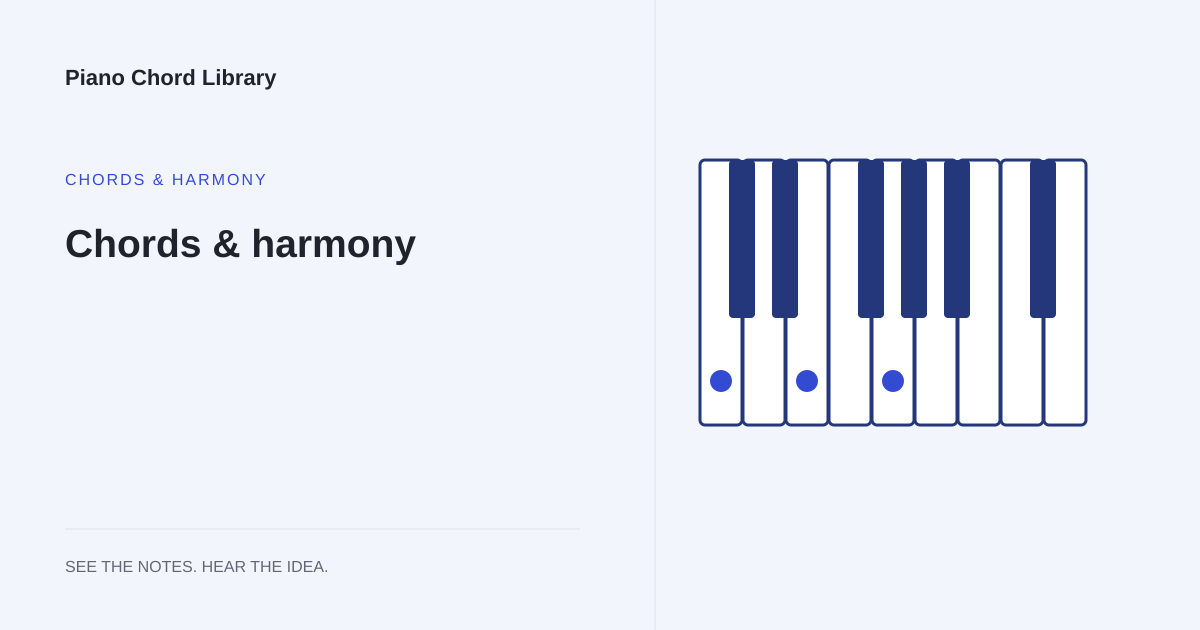
Find C–E–G, then keep C and G still while lowering E to E♭. You have changed C major to C minor. Now restore E and add B♭ above G: C–E–G–B♭ is C7. The minor third and the minor seventh do different jobs; a plain 7 does not mean a minor triad.
Three chords with the same C root
Symbol
Notes
What changed from C major?
C
C–E–G
Starting triad
Cm
C–E♭–G
Third lowered a semitone
C7
C–E–G–B♭
Minor seventh added
Hear each version in the chord explorer, or use the C7 reference for a worked resolution into F major. When you can name the changed member, choose a guide below to investigate why the chord moves that way.
Spell diminished seventh chords accurately, including double flats, and explore their symmetry through original piano examples and carefully traced resolutions.
Build half-diminished chords, compare their sevenths with fully diminished chords and practise an original minor-key progression with clear note spellings.
Build diminished piano triads with two minor thirds, hear their pull toward other chords, and distinguish the three-note triad from diminished sevenths.
Learn minor seventh chords through intervals, keyboard layouts and original progressions. Check Dm7, Am7, Em7 and Fm7 without relying on one hand shape.
Build dominant seventh chords and hear original V–I resolutions in major and minor keys, with clear voice leading, playable examples and spelling checks.
Build major, minor, diminished and augmented piano triads from intervals, with correctly spelled examples, original diagrams and a practical checking method.
 Piano Chord Library

 Rob