 Piano Chord Library
Rhythm & reading
How to read a piano keyboard diagram
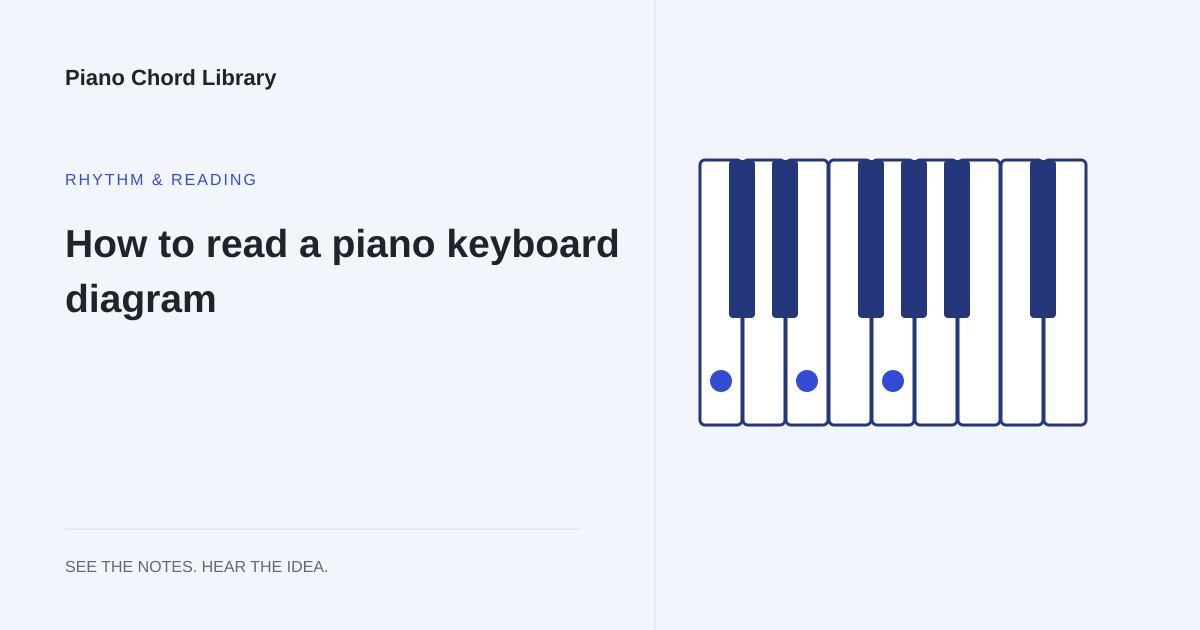
Find C, identify black-key groups and connect written note names to the highlighted piano keys.
Read the guide : How to read a piano keyboard diagramExplore the topic
Give each note and silence its place in time.
Explore durations, rests, subdivisions and short reading exercises. Beat diagrams connect notation to a steady pulse.
Count one 4/4 bar as “1 and 2 and 3 and 4 and”. Try a quarter-note C on beat 1, a quarter rest on beat 2, eighth-note D and E on beat 3 and its “and”, then a quarter-note G on beat 4. The rest uses time just as the sounded notes do.
| Count | 1 | and | 2 | and | 3 | and | 4 | and |
|---|---|---|---|---|---|---|---|---|
| Action | Start C | Hold C | Rest | Stay silent | Play D | Play E | Start G | Hold G |
Clap only the starts first: 1, 3, the “and” after 3, and 4. Then find those pitches using the keyboard-diagram guide. Counting continuously through beat 2 is the check; do not compress the silence to reach D sooner.
The quarter C lasts one beat, the rest lasts one beat, D and E together last one beat, and the quarter G lasts one beat: four beats in total. The eight counting positions are subdivisions, not eight quarter-note beats.
Duration reference: Music Theory for the 21st-Century Classroom: durational symbols. The one-bar example and counting check are original.
1 published guide
Find C, identify black-key groups and connect written note names to the highlighted piano keys.
Read the guide : How to read a piano keyboard diagramA little more context
Yes. A rest occupies a defined duration. Keep counting through silence so the next note begins in the right place.
A triplet divides a stated duration into three equal parts where two of the same written values would normally fit.
 Rob