Piano Chord Library
 Rob

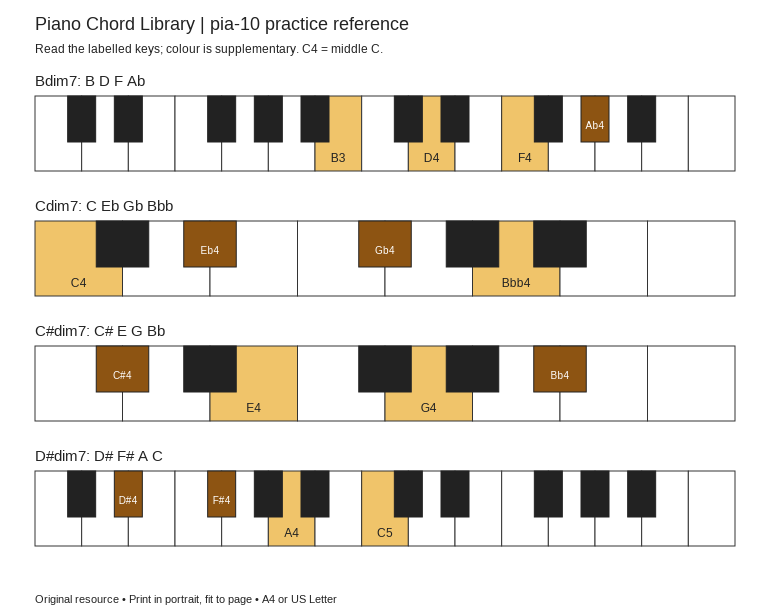
A fully diminished seventh chord contains a root, minor third, diminished fifth and diminished seventh. Its root offsets are zero, three, six and nine semitones. Bdim7 is B–D–F–A-flat. Cdim7 is C–E-flat–G-flat–B-double-flat, with the last note played on the A key. Correct spelling explains the chord even when several names share the same piano keys.
| Written note | Played key in equal temperament | Role |
|---|---|---|
| C4 | C4 | Root |
| E♭4 | E♭4 | Minor third |
| G♭4 | G♭4 | Diminished fifth |
| B𝄫4 | A4 | Diminished seventh |
The original keyboard reference and audio compare Bdim7, Cdim7, C-sharpdim7 and D-sharpdim7. Each chord is played as separate notes followed by the full sound. Use the major and minor chord references for the tonic destinations in the original resolution exercises below.
Original printable reference
Open the full-size sheet to inspect the notation, then use your browser’s Print / save PDF.
Build three consecutive minor thirds
Start with B3. A minor third above it is D4, three semitones higher. Another minor third gives F4, and another gives A-flat4. The adjacent gaps are all three semitones. From the original root B, the three upper tones therefore sit at three, six and nine semitones respectively.
The lowest three notes B–D–F already form a diminished triad. Adding A-flat creates the diminished seventh above B and completes the four-note chord. If you add A natural instead, the result is half-diminished. The triad underneath remains the same, so the seventh must be checked explicitly.
Three stacked minor thirds do not mean three notes. Each new interval adds another member above the first one, giving four notes in total. Likewise, the number seven in the chord name describes the letter span from root to final member, not the number of keys you play.
Why Cdim7 uses B-double-flat
Write the letter framework C, E, G and B. E-flat supplies the minor third, and G-flat supplies the diminished fifth. The seventh must still use some kind of B. B-flat would be a minor seventh, ten semitones above C. Lowering B-flat once more gives B-double-flat, nine semitones above C.
On the piano, B-double-flat uses the A key. That does not make the spelling pointless. C to A spans six letters and is a sixth; C to B-double-flat spans seven letters and is a diminished seventh. The written name shows which chord member is present, while the key tells you where to play it.
Think of the double flat as two successive alterations of the letter B. B lowers to B-flat, then lowers again to B-double-flat. It is not an instruction to move down two semitones from whatever altered note you already happen to be playing. Accidentals belong to the named letter, and the full spelling must be read as a unit.
A useful comparison is C6 versus Cdim7. C6 contains C, E, G and A, while Cdim7 contains C, E-flat, G-flat and B-double-flat. The final physical key may be A in both, but the underlying third, fifth and written role differ. Recognising one shared key cannot establish a chord's identity.
Check C-sharp and D-sharp examples
C-sharpdim7 uses C-sharp, E, G and B-flat. C-sharp to E is three semitones, E to G is three and G to B-flat is three. The outer interval C-sharp to B-flat spans seven letters and nine semitones. This example achieves the diminished seventh with a single flat on its final member.
D-sharpdim7 uses D-sharp, F-sharp, A and C. The same three-semitone stack starts a whole step higher. D-sharp to C above is a diminished seventh, despite C having no accidental. An interval's quality depends on the relationship between both endpoints, not on how many symbols appear next to the upper note.
Try constructing G-sharpdim7 independently. Its letter framework is G, B, D and F, and the correct spelling is G-sharp–B–D–F. The three upper notes happen to be natural. Counting from the sharp root confirms the offsets three, six and nine. This is a useful exercise if you tend to expect diminished chords to require a flat on every note.
Understand the equal spacing around the octave
After B–D–F–A-flat, another minor third reaches the next B. The chord divides the octave into four equal three-semitone steps. In pitch-class terms, rotating the collection by three semitones returns the same set of piano keys. This symmetry makes fully diminished sevenths different from ordinary major or minor seventh chords.
There are three distinct fully diminished seventh pitch-class collections in twelve-tone equal temperament. One is C, E-flat, G-flat and A as sounding keys. A second is C-sharp, E, G and B-flat. A third is D, F, A-flat and B. Moving the root another semitone after the third collection returns to a rearrangement of the first.
That statement concerns pitch-class sets, not every possible written chord or voicing. Different spellings can identify different roots and resolutions, and different registers produce different arrangements. Saying there are only three diminished-seventh sets must not become a reason to erase all the distinctions that written harmony preserves.
Separate inversion from reinterpretation
Take B–D–F–A-flat and put D lowest. You can still hear and label it as Bdim7 in first inversion if the surrounding music treats B as the root. The new bass does not automatically rename the chord. The other inversions place F or A-flat lowest while retaining the B-root interpretation.
To reinterpret the same sounding keys as Ddim7, spell them D–F–A-flat–C-flat. C-flat uses the B key. This spelling creates a third-based stack above D, giving D a different root role. The physical keys can match while the notation and harmonic meaning change.
Similarly, an F-root spelling is F–A-flat–C-flat–E-double-flat. E-double-flat uses the D key. These more complex names are not necessary for every beginner performance, but they show why symmetrical sound does not mean arbitrary notation. A careful analysis chooses the spelling that makes the intended function and melodic movement intelligible.
Hear a leading-tone diminished seventh resolve
G-sharpdim7 can lead to A minor. G-sharp lies a semitone below A, and the chord G-sharp–B–D–F can be built on the raised seventh degree of A harmonic minor. Labelled in that key, it is vii°7. The leading tone G-sharp supplies a clear upward movement toward the tonic.
For an original four-voice comparison, play G-sharp3–B3–D4–F4, then A3–C4–C4–E4 conceptually as four lines. Two lines converge on C4, so the actual piano destination uses A3, C4 and E4. The movements are G-sharp up to A, B up to C, D down to C and F down to E.
On the instrument you cannot sound two separate C4 keys, because there is only one. The duplicated destination represents two notional voices meeting on the same pitch. For a cleaner physical exercise, isolate G-sharp–F moving to A–E, then play the complete A minor triad. Keep the distinction between written voice-leading analysis and playable keys clear.
These examples illustrate a common tonal resolution, not every stylistic rule for part writing. A formal four-part arrangement may redistribute or double notes differently. The important observation is the actual small movement of chord tones into the tonic, rather than a claim that a diminished seventh always resolves in one fixed way.
Compare a major destination
C-sharpdim7 can lead to D major. Use C-sharp4–E4–G4–B-flat4, then D4–F-sharp4–A4. Track C-sharp rising to D, G falling to F-sharp and B-flat falling to A. E can move to F-sharp or D depending on the chosen voicing. The destination's major third F-sharp helps distinguish this arrival from D minor.
Now play the same diminished seventh into D minor, D–F–A. C-sharp still rises to D, but the tonic third is F natural. The same leading-tone seventh chord can therefore precede a major or minor tonic, with voice-leading adjusted to the destination. Hearing the final chord is necessary before deciding the complete key context.
For a manageable keyboard reduction, play C-sharp3 in the left hand with G4–B-flat4 in the right, then D3 with F-sharp4–A4 for D major. This omits E from the diminished chord. Add E4 when the basic movement is clear and if the spacing is comfortable. The reduction is an exercise, while the full spelling remains C-sharp–E–G–B-flat.
Use one as a short connecting chord
Try the original sequence C major, C-sharpdim7, D minor and G7. Its complete spellings are C–E–G, C-sharp–E–G–B-flat, D–F–A and G–B–D–F. The bass rises chromatically C–C-sharp–D before moving to G. The C-sharp chord can be understood as a leading-tone diminished seventh directed toward D minor.
Keep C major and C-sharpdim7 close by holding E and G while changing the bass C to C-sharp and adding B-flat. Then resolve to D minor. Listen to B-flat falling to A and C-sharp rising to D. Those directed movements give the connecting chord a purpose beyond adding an unfamiliar sound between familiar triads.
Do not label every chromatic passing chord as a diminished seventh without checking its notes. A passing bass note might sit under an unchanged harmony, or another chord quality might connect the same endpoints. Here the explicit C-sharp, E, G and B-flat stack confirms the diminished-seventh construction before you discuss its connecting role.
A written spelling drill with reasoning
- Construct Fdim7 from the letters F, A, C and E. A-flat gives the minor third; C-flat gives the diminished fifth; E-double-flat gives the diminished seventh. The sounding keys are F, A-flat, B and D. Keep both lists if necessary, but mark which is the theoretical spelling and which describes physical key locations.
- Construct Edim7 next. E–G–B-flat–D-flat supplies the same interval structure with simpler accidentals. The contrast shows that awkward spelling comes from the chosen root name, not from a different underlying chord family. Play the two chords separately and verify three minor thirds in each before comparing their overall sounds.
- For a reverse task, identify C-sharp, E, G and B-flat. They already form a stack of thirds, so C-sharp is the clear root-based spelling. Now move G to the bass without changing any note names. The result is second inversion of C-sharpdim7, because the fifth is lowest. Your answer should preserve both root and bass information.
Listen without relying on symmetry alone
A useful transfer check starts with a target rather than a chord name. Choose E minor as the destination and find the leading tone a semitone below E: D-sharp. Build three minor thirds above it to get D-sharp–F-sharp–A–C, the final recorded example. Then compare its members with E–G–B. D-sharp can rise to E, F-sharp can rise to G, and C can fall to B. Play those lines in pairs before joining them. Starting from a destination makes the choice of D-sharp intelligible; calling the lowest sounding key E-flat would hide the leading-tone relationship that the exercise is designed to reveal.
Compare Bdim7 with Bø7 at the same register. Their lower B–D–F triad is identical, while the upper member is A-flat or A. Play the top pair in isolation before restoring the chord. A fully diminished seventh contains two tritones between opposite members; the half-diminished comparison changes that internal network when its seventh rises.
Next compare Bdim7 with B diminished triad. The triad lacks the seventh entirely, so its texture and interval content are different. Practise these two questions separately: is a seventh present, and which seventh is it? Mixing them immediately can make an uncertain answer hard to diagnose.
Vary the register after the first comparisons become familiar. A dense low voicing may obscure the upper note, while a widely spaced voicing makes individual tones easier to follow. Neither is more theoretically diminished. Chord identification needs to survive reasonable changes in register, volume and spacing rather than depend on a single recording.
Keep notation, sound and function aligned
Before calling a chord fully diminished seventh, check four things in order: a third-based letter stack, root offsets zero–three–six–nine, a correctly spelled seventh, and a context that supports the proposed root. The first three verify the chord construction; the last helps choose between enharmonic interpretations of its symmetrical pitch collection.
If your spelling uses A in Cdim7, change the written name to B-double-flat while leaving the piano key alone. If your Bdim7 contains A natural, change the pitch to A-flat or rename the chord half-diminished. These are different corrections, one notational and one sounding. Distinguishing them is the central practical skill of this chord family.
Finish with a short resolution you can explain note by note. C-sharpdim7 to D minor is a good choice because the leading tone C-sharp rises clearly to D. Write the full spellings, choose a comfortable voicing, play slowly and identify the moving voices in each hand. The chord's symmetry is then supported by a specific musical destination.
Theory references
- Introduction to Seventh Chords. Reviewed 7 October 2026.
- Augmented and Diminished Intervals. Reviewed 7 October 2026.
The explanations, exercises, keyboard drawings and synthesized audio on this page are original. References were used to check terminology and theory.