Piano Chord Library
 Rob

Build a piano triad by choosing a root, adding a third above it and adding a fifth above the root. A major triad uses a major third and perfect fifth; a minor triad changes the third to minor. Diminished and augmented triads change the fifth too. These interval relationships work from every starting note, even when the keyboard shapes look different.
When checking the distance from the root to each chord tone, use the music intervals guide to distinguish the interval number from its quality. Count letter names as well as semitones before deciding whether the third or fifth is correct.
| Quality | Degrees relative to major | C example |
|---|---|---|
| Major | 1–3–5 | C–E–G |
| Minor | 1–♭3–5 | C–E♭–G |
| Diminished | 1–♭3–♭5 | C–E♭–G♭ |
| Augmented | 1–3–♯5 | C–E–G♯ |
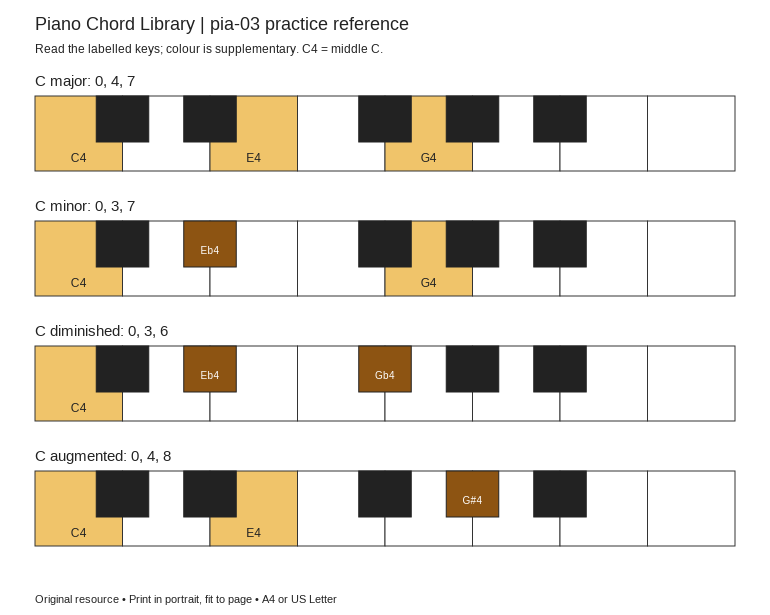
The original triad comparison sheet places all four qualities on C so you can see exactly which notes move. Listen to the audio in this order: C major, C minor, C diminished and C augmented. Each is played as separate notes followed by a simultaneous chord. The chord reference supplies more major and minor roots once the construction method is clear.
Understand root, third and fifth
The root gives a chord its letter name. For D minor, the root is D; for B-flat major, it is B-flat. The third and fifth describe relationships to that root. They do not mean the third and fifth fingers, and they do not necessarily identify the third and fifth white keys you happen to see.
Letter counting establishes the basic spelling. A triad on D uses some kind of D, F and A, because those letters make a third and fifth above D. A triad on B uses B, D and F. Accidentals then determine whether the actual distances produce major, minor, diminished or augmented quality. Keep the letter framework before deciding which black keys are needed.
A triad contains three distinct chord tones, but a performance can repeat them in several octaves. C3, G3, C4 and E4 still contain only C, E and G as pitch classes, so the harmony can remain C major. The number of keys currently sounding is therefore not always the number of different ingredients in the chord.
Two ways to read a chord formula
A root-distance formula measures every note from the same starting point. For a major triad, the offsets are zero, four and seven semitones. Zero is the root itself; four gives its major third; seven gives its perfect fifth. For a minor triad the offsets are zero, three and seven. Only the middle note changes.
A stacked-thirds formula measures each gap from the previous chord tone. Major uses four semitones followed by three. Minor uses three followed by four. Both totals reach seven semitones above the root, which explains their shared perfect fifth. Do not accidentally add the root-distance numbers four and seven as consecutive gaps; that would overshoot the intended fifth.
Diminished uses three plus three, reaching six semitones above the root. Augmented uses four plus four, reaching eight. The compact pattern is therefore major: four plus three; minor: three plus four; diminished: three plus three; augmented: four plus four. These describe close root-position triads, where the root is lowest and the other members are stacked directly above it.
Build D major from the ground up
Choose D4 as the root. The letters of the triad are D, F and A. A major third must lie four semitones above D: D-sharp is one, E is two, F is three and F-sharp is four. F-sharp is therefore the third. The fifth must lie seven semitones above D, which reaches A.
Play D4, F-sharp4 and A4 one at a time. Check the lower gap, D to F-sharp, as a major third. Then check F-sharp to A as three semitones, a minor third. Finally play the notes together. You have confirmed the chord through both root distances and adjacent gaps, giving two ways to catch a misplaced note.
Notice why D–G-flat–A is an unhelpful spelling for this chord. G-flat uses the same key as F-sharp in equal temperament, but the letter G is a fourth above D. Calling the third F-sharp shows its role in a D triad and in the D major scale. Correct spelling makes related musical patterns easier to recognise.
Change one ingredient to build D minor
Keep D and A where they are. Lower F-sharp by one semitone to F natural. The notes D, F and A form D minor. D to F now measures three semitones, while D to A remains seven. This is a controlled comparison: the changed third, rather than a different root or register, explains the change in quality.
Play D major and D minor in alternation, leaving a brief silence between them. Listen specifically to F-sharp falling to F. Then reverse the order and hear F rise to F-sharp. General descriptions such as bright or dark can be personal listening aids, but the reliable definition is the interval structure you can verify.
Do not lower every note to make a chord minor. Lowering D, F-sharp and A together would transpose the entire major chord down by a semitone. It would preserve the distances between its notes and therefore preserve major quality. Changing quality and transposing are different operations: one alters internal intervals, while the other moves the whole structure.
Work through a flat-root example
For B-flat major, first establish the letters B, D and F. From B-flat to D is four semitones, and from B-flat to F is seven. The chord is B-flat, D and F. Although the root is black and the other notes are white, the same major formula applies. A visual all-white shape is only one possible appearance of major quality.
To make B-flat minor, lower the third D to D-flat. Keep B-flat and F. Verify B-flat to D-flat as three semitones and D-flat to F as four. The resulting two-black-key layout may look less familiar than C minor, but its interval relationships are identical. Say the chord members as root, minor third and perfect fifth while playing.
Compare B-flat major with D major without rushing between them. Write the notes for each first, then build them on the keyboard. This avoids memorising a vague hand contour and dragging it sideways. White and black keys have different physical layouts, so the fingers may reorganise even when the interval formula stays constant.
Diminished and augmented constructions
Start with C minor: C, E-flat and G. Lower its fifth to G-flat and you have C diminished. The bottom gap C to E-flat is three semitones, and the upper gap E-flat to G-flat is also three. The outer interval C to G-flat is a diminished fifth, spanning six semitones rather than the seven of a perfect fifth.
Now return to C major: C, E and G. Raise its fifth to G-sharp and you have C augmented. Both adjacent gaps contain four semitones. Its outer interval is an augmented fifth, eight semitones above C. Keep the spelling G-sharp here; A-flat would suggest a sixth above C and obscure the altered fifth.
Try two independent constructions to check the rules. F-sharp diminished uses F-sharp, A and C; the semitone offsets are zero, three and six. F augmented uses F, A and C-sharp; its offsets are zero, four and eight. Both examples need careful spelling, and neither can be found reliably by counting only white notes.
Read a basic chord symbol
A plain letter generally indicates a major triad in a basic chord chart. D means D major. Dm indicates D minor. Ddim or D° indicates a diminished chord, while Daug or D+ indicates an augmented chord. Because conventions differ, use any legend provided by the score, especially where a diminished symbol might imply an added seventh.
The accidental attached directly to the root belongs to its name. In B-flat minor, written Bbm in plain text or B♭m in musical typography, the flat changes B to B-flat and the m specifies minor quality. It does not mean flatten the entire chord after building B minor. Read the root and the quality as two separate instructions.
Numbers such as 7 or 9 add further information beyond this three-note task. C7 is not simply a C major triad played seven times, and Cm7 contains another chord member. Establish the triad first, then study how the added interval changes it. That foundation makes longer symbols much less intimidating.
Rearrange notes without rebuilding the chord
C4–E4–G4 puts the root C at the bottom. Move C up an octave and E4–G4–C5 is still C major, now in first inversion. Move the lowest E above the others and G4–C5–E5 is second inversion. All three layouts preserve the pitch classes C, E and G.
The stacked-thirds formula no longer describes the adjacent gaps in every inversion. E to G is a minor third, but G to C is a perfect fourth. That does not make the chord stop being C major. To identify the quality, mentally restore the chord to its root-based letter stack or measure from the actual root C.
This distinction is useful when reading music that looks spread out. Suppose the left hand plays A2 and the right hand plays E4 and C5. The notes still make A minor. Their spacing affects register, texture and ease of playing, while the underlying chord tones remain A, C and E. You need not force them into one hand to recognise them.
A practical construction session
- For the first round, write four prompts on paper: E major, E minor, A major and A minor. Before playing, supply the letter frameworks E–G–B and A–C–E. Then add the needed accidentals. E major is E–G-sharp–B, E minor is E–G–B, A major is A–C-sharp–E and A minor is A–C–E.
- For the second round, choose a root you have not just played. Build its major and minor triads, then compare only the third. If you choose E-flat, the major third is G and the minor third is G-flat. The fifth B-flat remains fixed. This prevents the exercise becoming a memorised sequence of hand movements.
- For the final round, return to C and play the four qualities in the reference audio order. Say which chord member changes at each transition. Major to minor lowers the third; minor to diminished lowers the fifth; diminished to augmented raises both third and fifth. Explaining the changes makes the comparison more specific than merely recognising four different sounds.
Find the reason a chord sounds wrong
Check the root before adjusting anything else. A correctly built chord on the wrong starting note is a transposition error, not a quality error. Next isolate root and third, then root and fifth. Hearing and counting two-note relationships is easier than diagnosing a dense chord while every note rings together.
If your fifth lands too high, check whether you added seven semitones above the third rather than above the root. If your major and minor chords have different outer notes, check whether you moved the root or fifth unnecessarily. If the pitches sound right but your written letters repeat or skip the expected stack, review spelling.
Use the sustain pedal sparingly during these checks. Residual notes from the previous chord can make a correct new shape sound more complicated than it is. Release the keys, let the sound clear and play the intended chord again. The goal is a transparent comparison in which one specific musical change explains what you hear.
Turn construction into musical knowledge
A useful reverse exercise begins with notes rather than a chord label. Take F-sharp, B and D-sharp in that order. Rearrange their letters into B, D-sharp and F-sharp. The distances above B are four and seven semitones, so the chord is B major, with F-sharp as the original bass. This task checks whether the construction process also works backwards. It is especially helpful when a printed accompaniment presents an inversion that does not look like your first learned shape. Write the root separately from the lowest note so that the two ideas remain clear.
Choose two chords you can now build confidently and alternate between them in a slow, steady pulse. C major and A minor share C and E, so you can listen for the changing G and A while the common notes remain familiar. D minor and G major offer a different comparison because their roots, thirds and fifths change.
Write a short record of what you learned: one formula, one correctly spelled chord and one error you corrected. On your next practice day, build that chord from memory before looking at the answer. The purpose is to make the interval method available whenever an unfamiliar chord name appears, while gradually making familiar chords quicker to recognise.
Theory references
- Introduction to Triads. Reviewed 7 October 2026.
The explanations, exercises, keyboard drawings and synthesized audio on this page are original. References were used to check terminology and theory.