Piano Chord Library
 Rob
A half-diminished seventh chord combines a diminished triad with a minor seventh. Its formula is root, minor third, diminished fifth and minor seventh, or zero, three, six and ten semitones. B half-diminished is B–D–F–A. The same chord can be written Bø7 or Bm7(b5), meaning B minor seventh with its fifth lowered.
| C chord | Notes | Seventh above C |
|---|---|---|
| Cm7♭5 | C–E♭–G♭–B♭ | Minor seventh: ten semitones |
| Cdim7 | C–E♭–G♭–B𝄫 | Diminished seventh: nine semitones |
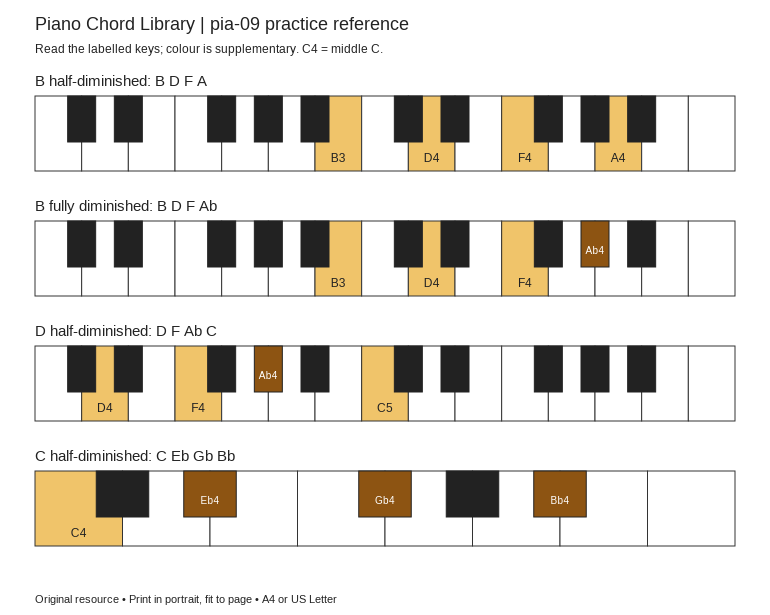
The original comparison sheet places B half-diminished beside B fully diminished, then adds D and C half-diminished examples. Hear that order below. The contrast isolates the seventh so you can connect the symbol, written notes and sound. The chord library provides underlying minor triads for the construction exercises.
Read m7-flat-5 as a set of instructions
Begin with Bm7: B, D, F-sharp and A. The m indicates a minor triad, and the 7 adds a minor seventh. The flat-five instruction lowers the fifth F-sharp by one semitone to F natural. The result is B, D, F and A. It does not lower the root or every note in the chord.
The alternative symbol Bø7 names the same four-note quality. The slashed circle distinguishes it from the unslashed circle used for a fully diminished chord. In small type the difference can be easy to miss, so check any available written notes. A plain-text m7(b5) spelling can be clearer when special symbols do not display well.
The flat in flat-five is relative to the perfect fifth, not necessarily a literal flat sign on the page. B's perfect fifth is F-sharp, so its lowered fifth is F natural. D's perfect fifth is A, so its lowered fifth is A-flat. Understanding the operation avoids writing F-flat accidentally in a B half-diminished chord.
Check B half-diminished from the root
Play B3 and D4. The distance is three semitones, a minor third. Add F4, six semitones above B3, to supply the diminished fifth. Finally add A4, ten semitones above B3, to supply the minor seventh. You now have the complete root-position chord B3–D4–F4–A4.
The adjacent thirds are minor, minor and major: B–D is three semitones, D–F is three, and F–A is four. The last gap is therefore different from the first two. This is a useful way to distinguish the chord from a fully diminished seventh, whose root-position stack uses three minor thirds.
All four notes are white keys, but the chord contains a diminished fifth. That makes Bø7 a useful reminder that keyboard colour is not chord quality. Write the interval labels under the notes and play each root-based pair separately. The construction becomes much clearer when every member has a role you can explain.
Compare half-diminished with fully diminished
Keep B, D and F fixed. For half-diminished, add A; for fully diminished, add A-flat. A is a minor seventh above B, while A-flat is a diminished seventh above B. Only the top member changes in this root-position comparison, so the two sounds can be contrasted without changing the root or the lower triad.
The word half does not mean the chord is played softly, contains half as many notes, or is a partial version of some required complete chord. Both families have four distinct members. It distinguishes the combination of a diminished triad with a minor seventh from the combination of a diminished triad with a diminished seventh.
Try the reverse comparison from a full minor seventh. Bm7 is B–D–F-sharp–A; lower F-sharp to F for Bø7; then lower A to A-flat for Bdim7. This two-stage path makes the changing fifth and seventh visible. It also shows why half-diminished is not simply another name for an ordinary minor seventh.
Build D and C examples with correct spelling
Dø7 uses the letters D, F, A and C. D to F is already a minor third, D to C above is already a minor seventh, but D to A is a perfect fifth. Lower A to A-flat. The result D–F–A-flat–C follows the required offsets zero, three, six and ten.
Cø7 starts from C, E, G and B as a letter framework. Lower E to E-flat for the minor third, G to G-flat for the diminished fifth and B to B-flat for the minor seventh. C–E-flat–G-flat–B-flat is the complete spelling. The three flats are a consequence of this root, not a universal visual recipe.
Do not replace G-flat with F-sharp in that C chord merely because the keys match. G-flat is some kind of G, making it a fifth above C. F-sharp is some kind of F, making it a fourth. Correct chord spelling shows alternate letters and makes the lowered fifth visible to anyone reading the notes.
Hear the chord as ii half-diminished in minor
Build the minor-key progression
In A minor, the second degree is B. Taking B, D, F and A from the natural-minor collection produces Bø7, often labelled iiø7. It can lead to E7 and then Am. The minor-key ii–V–i sequence is a particularly useful context for hearing a half-diminished chord prepare a dominant.
For an original complete spelling exercise, write B–D–F–A, E–G-sharp–B–D and A–C–E. Compare the first two chords before playing. B and D are common tones; F can move to E, while A can move to G-sharp. The raised G-sharp in E7 supplies the leading tone to A.
Listen to the arrival
One compact piano arrangement uses left-hand roots B2, E3 and A2. Put D4–F4–A4 above B, D4–E4–G-sharp4 above E, and C4–E4–A4 above A. The E7 omits its fifth B. Its defining third G-sharp and seventh D remain, so the dominant function is clear in the progression.
Track the top voice A4–G-sharp4–A4 first. Then track the lower upper-voice line D4–D4–C4. Two simple melodic paths emerge inside the harmony. Play each path alone, then restore the chords. This turns the sequence from three memorised shapes into several connected lines you can hear and explain.
The same quality also belongs to major keys
In C major, B is the seventh scale degree. B–D–F–A therefore forms viiø7 when built entirely from the major scale. The chord's notes are identical to iiø7 in A minor, but the scale-degree label and harmonic role differ. A root-and-quality symbol gives the chord contents; a Roman numeral relates them to a key.
Establish C as home by playing C major first, then Bø7 and back to C. Compare that short experiment with Am–Bø7–E7–Am. The surrounding chords encourage a different hearing of the same B–D–F–A collection. Context matters, so an isolated half-diminished chord cannot prove which key a passage occupies.
Minor scales also vary according to their melodic and harmonic use. Avoid a rule that all minor-key seventh chords must come from one unchanging natural-minor scale. In the A minor example, Bø7 fits natural minor while E7 needs G-sharp. The two chords work together because tonal minor commonly alters scale degrees for harmonic purposes.
Use a layout that reveals the important notes
For Bø7, give B3 to the left hand and D4–F4–A4 to the right. The right-hand group happens to be a D minor triad, but the whole chord over B is B half-diminished. This is a useful construction shortcut only if you retain the bass relationship; D minor by itself is a different harmony.
Another layout is B2–F3 in the left hand and A3–D4 in the right. The low pair contains the root and diminished fifth, while the upper pair contains the seventh and third. Do not force the stretch if that arrangement is uncomfortable. A single B bass with the other tones higher communicates the same four pitch classes.
First inversion puts D lowest; second inversion puts F lowest; third inversion puts A lowest. The chord remains Bø7 while its root-based identity is maintained. To check a scattered voicing, gather the pitch classes mentally as B–D–F–A. Applying the construction formula to whichever note happens to be lowest can lead to a false chord name.
Transpose the minor progression to C minor
Move every note of the A minor progression up a minor third. Bø7 becomes Dø7, E7 becomes G7 and Am becomes Cm. The complete spellings are D–F–A-flat–C, G–B–D–F and C–E-flat–G. The quality sequence stays half-diminished, dominant seventh, minor triad.
A practical arrangement uses D3 with F4–A-flat4–C5, G3 with F4–G4–B4, then C3 with E-flat4–G4–C5. Compare its upper lines with the A minor version. C falls to B and returns to C; F stays for the dominant then falls to E-flat. The last fall is a whole step, fitting the minor tonic's third.
This transfer checks more than moving your hands. A-flat belongs to Dø7 as its diminished fifth, while B natural belongs to G7 as its major third. The C minor destination uses E-flat. Say these altered notes explicitly so that the change of key does not lead you to keep an accidental from the earlier A minor layout.
Diagnose an uncertain sound
If the chord sounds like a familiar minor seventh, inspect the fifth. In Dø7, A-flat must replace A. If it sounds like the fully diminished comparison, inspect the seventh. Dø7 uses C natural, whereas Ddim7 uses C-flat. The lower diminished triad D–F–A-flat remains identical in those two four-note forms.
If a notation exercise gives you four adjacent letters, restore the third-based framework before checking pitches. A half-diminished chord on E uses E, G, B and D. E–G–B-flat–D is correct; replacing B-flat with A-sharp obscures the fifth. The piano alone cannot show why that spelling matters, so keep the written names beside the keyboard task.
If the progression becomes difficult only when both hands play, practise the bass route and upper shapes separately. Then join just the first change, Bø7 to E7, and pause. The goal is to preserve the specific common notes and semitone movements, not to get through the whole loop with approximate chord contents.
A final written and listening check
- Before testing speed, check whether your answer distinguishes pitch content from position. B3–D4–F4–A4 and A3–B3–D4–F4 contain the same half-diminished chord members, but the second places the seventh in the bass. Its small A–B gap may make it look unlike your original diagram. Write B as the root and A as the bass, then identify the inversion. This is third inversion. If you instead build a fresh formula upward from A, you are analysing a different hypothesis. Restoring the root-based spelling first keeps identification consistent when an accompaniment rearranges the notes.
- Construct F-sharpø7. Its letter framework is F, A, C and E, and its actual spelling is F-sharp–A–C–E. The diminished fifth C lies six semitones above F-sharp and the minor seventh E lies ten. Compare F-sharp minor seventh, which would use C-sharp, then fully diminished F-sharp, which would use E-flat.
- Listen to those three versions while keeping F-sharp and A unchanged. First the fifth falls from C-sharp to C; then the seventh falls from E to E-flat. Name the moving member each time. This combines construction and listening in a way that a static chord-name quiz cannot, and it gives you a clear method for correcting an uncertain answer.
- Finish by playing one minor iiø7–V7–i progression from the guide and writing its full chord spellings without looking at the printed answers. If you can identify the diminished fifth, distinguish the two possible sevenths and follow the resolution into the tonic, the half-diminished symbol has become a practical musical instruction.
Theory references
- Introduction to Seventh Chords. Reviewed 7 October 2026.
- Roman Numerals of Diatonic Seventh Chords. Reviewed 7 October 2026.
The explanations, exercises, keyboard drawings and synthesized audio on this page are original. References were used to check terminology and theory.