Piano Chord Library
 Rob
A seventh chord extends a triad with a fourth distinct note, a seventh above the root. Changing the third, fifth or seventh creates different chord families. Cmaj7, C7 and Cm7 share a root but contain different intervals. Half-diminished and fully diminished sevenths alter the fifth as well. Comparing all five on C makes each change easy to see and hear.
| Family / symbol | Formula | C spelling |
|---|---|---|
| Major seventh / Cmaj7 | 1–3–5–7 | C–E–G–B |
| Dominant seventh / C7 | 1–3–5–♭7 | C–E–G–B♭ |
| Minor seventh / Cm7 | 1–♭3–5–♭7 | C–E♭–G–B♭ |
| Half-diminished / Cm7♭5 | 1–♭3–♭5–♭7 | C–E♭–G♭–B♭ |
| Diminished seventh / Cdim7 | 1–♭3–♭5–♭♭7 | C–E♭–G♭–B𝄫 |
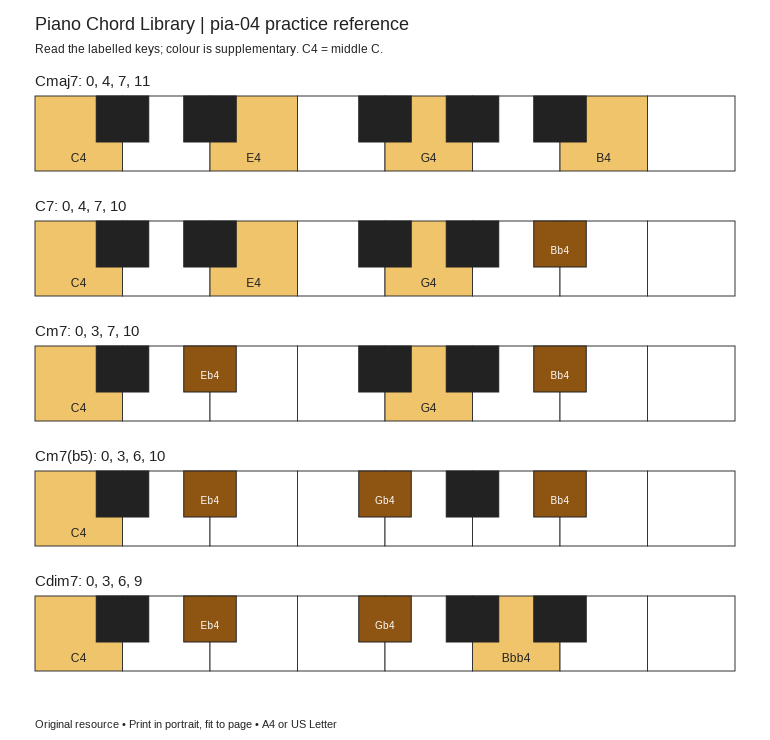
Start with the printable five-chord comparison. The original audio plays Cmaj7, C7, Cm7, Cm7-flat-5 and Cdim7, each as individual tones followed by the full chord. The timbre is synthesized; the notes and tuning are specified in the downloadable audio manifest. For three-note foundations, explore the major and minor chord references.
A seventh chord has four named members
If root, third and fifth are still unfamiliar, review the major and minor triad comparison before adding the seventh. Keep the underlying three-note structure clear as the extra member changes the chord family.
The members are root, third, fifth and seventh. Those labels describe intervals above the root, regardless of the order in which you play them. A chord beginning on C uses the letter framework C, E, G and B. Flats, sharps and sometimes double flats adjust the exact distances without changing that underlying sequence of alternate letters.
In root position the root is the lowest sounding chord tone. A close root-position C seventh chord puts some kind of C, E, G and B in ascending order. You can check it as three stacked thirds. Later you can move members to other octaves, but the root-based spelling remains the clearest starting point for identifying its family.
Seventh means a written interval, not seven notes in the chord. C to B spans C, D, E, F, G, A and B: seven letter positions. Only four of those letters are selected for the chord. A performance may double some of the four tones, but the chord still has four distinct ingredients.
Major seventh: a major triad plus a major seventh
Cmaj7 contains C, E, G and B. From the root, those notes sit at zero, four, seven and eleven semitones. C–E–G is the familiar major triad; B adds a major seventh above C. In close root position, the adjacent thirds measure four, three and four semitones.
Play C4–E4–G4 first and let it clear. Then add B4. Focus on the new top note rather than judging the entire chord with an adjective. B4 lies a semitone below C5, so the major seventh can also be understood as almost an octave. That relationship helps you locate the seventh quickly from a familiar octave boundary.
The symbol maj7 specifies a major seventh, not merely a major triad with any seventh. Fmaj7 therefore uses F, A, C and E; B-flatmaj7 uses B-flat, D, F and A. If you lower the last note in either example by a semitone, you change the chord family to dominant seventh. The root and major triad can stay fixed while the label changes.
Dominant seventh: keep the major third, lower the seventh
C7 contains C, E, G and B-flat. Its root offsets are zero, four, seven and ten semitones. Compare it directly with Cmaj7 by moving only B to B-flat. A plain 7 after a root normally indicates this dominant-seventh quality in a chord symbol. It does not indicate a major seventh unless the symbol says so.
The name dominant can refer to a role in a key as well as to this chord quality. G7 is the dominant seventh of C major because G is the fifth scale degree and the chord commonly leads to C. C7 has dominant-seventh quality wherever it appears, but its harmonic role depends on the surrounding music. A blues accompaniment, for example, may use that quality on several scale degrees.
Listen to the pair E and B-flat inside C7. Those two notes form a tritone, spanning six semitones. In a familiar C7-to-F resolution, E can rise to F and B-flat can fall to A. The small opposing movements explain an important part of the transition. You can hear that connection with just two upper voices and a changing bass.
Minor seventh: lower the third too
Cm7 contains C, E-flat, G and B-flat. Its offsets are zero, three, seven and ten semitones. It combines a minor triad with a minor seventh. To change C7 into Cm7, lower E to E-flat and keep the other three notes. The bottom third changes, while the fifth and seventh above C remain the same.
Try Dm7 as an independent example: D, F, A and C. D to F is a minor third, D to A a perfect fifth, and D to C above it a minor seventh. This all-white-key layout is convenient, but it does not define the family. Fm7 uses F, A-flat, C and E-flat and has exactly the same interval pattern.
Minor seventh does not mean a minor triad with a major seventh. C–E-flat–G–B is a separate minor-major seventh chord, commonly written Cm(maj7). That chord is outside the five main comparisons here, but recognising the distinction prevents a common construction error. Check the third and seventh independently instead of assuming the word minor governs every possible interval.
Half-diminished: a diminished triad plus a minor seventh
Cm7-flat-5 contains C, E-flat, G-flat and B-flat. You may see it written Cm7(b5) or Cø7. The chord has root offsets zero, three, six and ten semitones. Compared with Cm7, only the fifth changes: G falls to G-flat. Compared with a C diminished triad, it adds the minor seventh B-flat.
The name half-diminished can sound like an instruction to perform only half an alteration. A more practical interpretation is to remember both components: diminished triad underneath, minor seventh above the root. The lower three notes do not differ from the corresponding fully diminished chord; the distinction lies in which seventh completes the four-note structure.
Use Bø7 to see a naturally spelled example. B, D, F and A are all white keys. B–D–F is diminished because B to F spans six semitones. A lies ten semitones above B, supplying the minor seventh. Nothing about an all-white layout guarantees major or minor quality; the measured relationships decide.
Fully diminished: lower the seventh again
Cdim7 contains C, E-flat, G-flat and B-double-flat. Its offsets are zero, three, six and nine semitones. The final note sounds on the A key of an equal-tempered piano, but it is spelled B-double-flat because it must remain a seventh above C. C to A would be a sixth by letter count.
The double flat is not decorative complexity. It records that an ordinary B is lowered twice: B to B-flat and then B-flat to B-double-flat. The resulting interval C–B-double-flat is a diminished seventh, one semitone smaller than the minor seventh C–B-flat. It is the seventh that distinguishes this chord from Cm7-flat-5.
An easier spelling for a first performance is Bdim7: B, D, F and A-flat. Here the diminished seventh B–A-flat needs only one flat. Both versions consist of three stacked minor thirds. The equal three-semitone spacing creates a symmetrical pitch collection, which helps explain why fully diminished chords can be reinterpreted in several harmonic contexts.
Compare the families with one controlled chain
Set C4 as the unchanged root for the whole chain. Begin with Cmaj7 and lower B4 to B-flat4 for C7. Next lower E4 to E-flat4 for Cm7. Then lower G4 to G-flat4 for Cm7-flat-5. Finally lower B-flat4 to B-double-flat4 for Cdim7. Every step alters one chord tone by a semitone.
The final physical key is A4, but keep the written name B-double-flat in your notes for this C-root example. If the notation feels unfamiliar, say both parts aloud: written B-double-flat, played on the A key. This connects the instrument location to the correct role instead of treating one name as a mistake.
Reverse the chain after a short pause. Cdim7 to half-diminished raises the seventh; half-diminished to minor seventh raises the fifth; minor seventh to dominant seventh raises the third; dominant seventh to major seventh raises the seventh. Reversing the order checks whether you understand each operation rather than only remembering a downward sequence.
Choose a playable register and spacing
The diagram uses a compact register for comparison, but your hands need not hold every chord as a single four-note grip. Put the root in the left hand and the other three tones in the right, or divide two notes to each hand. The chord quality comes from the pitches, not from a prescribed distribution between the hands.
When moving to a low register, close spacing can sound dense. Compare C3–E3–G3–B3 with C3 in the left hand and E4–G4–B4 in the right. The second version opens the spacing while preserving the same pitch classes. This exercise separates chord identity from the clarity or weight of a particular voicing.
Keep the first listening comparisons in the same register and with similar loudness. If one chord is played loudly at the bottom of the keyboard and another softly near the top, the differences in tone and register can overshadow the interval changes you are studying. Once you recognise the construction, vary those features deliberately.
Recognise sevenths when the root is not lowest
A four-note seventh chord has root position and three inversions. For Cmaj7, the close layouts are C–E–G–B, E–G–B–C, G–B–C–E and B–C–E–G, ascending with appropriate octaves. The bass notes are root, third, fifth and seventh respectively. The collection C, E, G and B remains unchanged.
A close inversion often places a second between adjacent notes. In E4–G4–B4–C5, B and C are a semitone apart. That small gap is a consequence of the seventh wrapping around the octave. It does not mean the chord has acquired a new note. Restore the root-based ordering before applying your construction formula.
A slash symbol can clarify the bass, such as Cmaj7/E. Read the part before the slash as the chord and the part after it as the bass note. Here E is already a member of Cmaj7, so the slash specifies first inversion. More complicated slash chords can use a bass outside the chord; those need their own analysis.
Hear a seventh chord inside a progression
Build Dm7, G7 and Cmaj7 in that order. Their notes are D–F–A–C, G–B–D–F and C–E–G–B. In C major this gives ii7–V7–Imaj7. The three chords belong to different families even though all their notes come from the same major scale. The starting degree determines how the scale's intervals stack.
First play each chord in root position to check its contents. Then move only the bass roots with the left hand while choosing nearby right-hand notes. One simple upper-voice path is F4–A4–C5, then F4–G4–B4, then E4–G4–B4. Add D3, G3 and C3 below those shapes. The middle chord omits its fifth D but retains G7's third B and seventh F.
That reduced middle voicing illustrates a practical distinction. A complete theoretical spelling tells you all members of the chord. A chosen performance voicing may omit a member, often the fifth, while keeping enough context to communicate the harmony. During identification practice, begin with complete spellings so that intentional omissions do not become accidental gaps in understanding.
A three-part practice plan
- Spend the first part constructing two related families on a fixed root. Major seventh versus dominant seventh is a good first pair because only the seventh moves. Write both spellings before playing. Then close your eyes for the sound comparison if that is comfortable, keeping the pace slow enough to notice the changing upper note.
- For the second part, compare minor seventh with half-diminished. On D, Dm7 is D–F–A–C and Dø7 is D–F–A-flat–C. The seventh remains C, so the fifth carries the distinction. Play only D and A, then D and A-flat, before restoring F and C. Isolating the changed interval makes the full comparison clearer.
- For the third part, build a chord from a mixed prompt. Try Fmaj7, E7, Am7, Bø7 and Bdim7 in a shuffled order. Check the answer through root intervals rather than resemblance to a recent hand shape. Fmaj7 is F–A–C–E; E7 is E–G-sharp–B–D; Am7 is A–C–E–G; the two B chords differ only in A versus A-flat.
Resolve the most common mix-ups
Check the whole comparison on F
A second root provides a useful transfer test after the C comparison. Write the letters F, A, C and E in four rows, leaving room for accidentals. Fmaj7 uses those letters unchanged. F7 lowers E to E-flat. Fm7 also lowers A to A-flat. Fm7-flat-5 lowers C to C-flat while keeping E-flat. The final version, Fdim7, lowers E-flat once more to E-double-flat.
Locate C-flat on the B key and E-double-flat on the D key, but preserve their written names beside the exercise. Check the distances from F rather than memorising the accidentals: the diminished fifth C-flat lies six semitones above F, and the diminished seventh E-double-flat lies nine. This example shows why a correct chord can have several unfamiliar written notes even when its physical keys are ordinary.
Now explain why F–A-flat–B–D is a poor root-based spelling for Fdim7. The pitches match on a standard piano, but F to B is a fourth and F to D a sixth by letter count. Rewriting B as C-flat and D as E-double-flat restores the third, fifth and seventh framework. This is a notation correction, not a request to press different keys.
For a final written check, cover all five F answers and rebuild only F7 and Fm7-flat-5. These differ in both their third and fifth, while sharing F and E-flat. First compare A with A-flat over the fixed root, then C with C-flat. When you restore the complete chords, you should know which two movements account for the change rather than treating the unfamiliar shape as an indivisible object.
If this feels much harder than the C version, keep the two-root scope for another session. Speed through twelve roots is less informative than explaining two accurately. A correct explanation should include the chord symbol, four spelled members, the changed interval and the physical key for any unusual accidental. Once those agree, further roots use the same reasoning.
If C7 and Cmaj7 look identical in your notes, check the seventh: B-flat for C7, B for Cmaj7. If Cm7 has E natural, you have retained a major third and built C7 instead. If Cm7-flat-5 still has G natural, the altered fifth is missing. Each error can be diagnosed at one specific member rather than by rebuilding everything.
If you call C–E-flat–G-flat–A a Cdim7 spelling, the sounding pitches fit but the last written role does not. Rewrite A as B-double-flat for a root-based C diminished seventh. A keyboard diagram can show the same physical key while labelling the theoretically appropriate note. The ability to distinguish spelling from key location becomes increasingly useful in harmony.
Finally, do not infer chord function from quality alone. An E7 can lead strongly to A minor, but its role in another progression depends on context. These five family names identify the internal intervals. Hearing how a chord begins, continues or ends a phrase requires listening to the chords around it as well as checking the notes inside it.
Theory references
- Introduction to Seventh Chords. Reviewed 7 October 2026.
The explanations, exercises, keyboard drawings and synthesized audio on this page are original. References were used to check terminology and theory.