Piano Chord Library
 Rob

A diminished triad contains a root, minor third and diminished fifth. Its notes sit zero, three and six semitones above the root, or form two stacked minor thirds. B diminished is B–D–F; C diminished is C–E-flat–G-flat. The diminished fifth gives the chord a different relationship from the perfect fifth found in ordinary major and minor triads.
| Chord | Formula | B example |
|---|---|---|
| Diminished triad | 1–♭3–♭5 | B–D–F |
| Half-diminished seventh | 1–♭3–♭5–♭7 | B–D–F–A |
| Fully diminished seventh | 1–♭3–♭5–♭♭7 | B–D–F–A♭ |
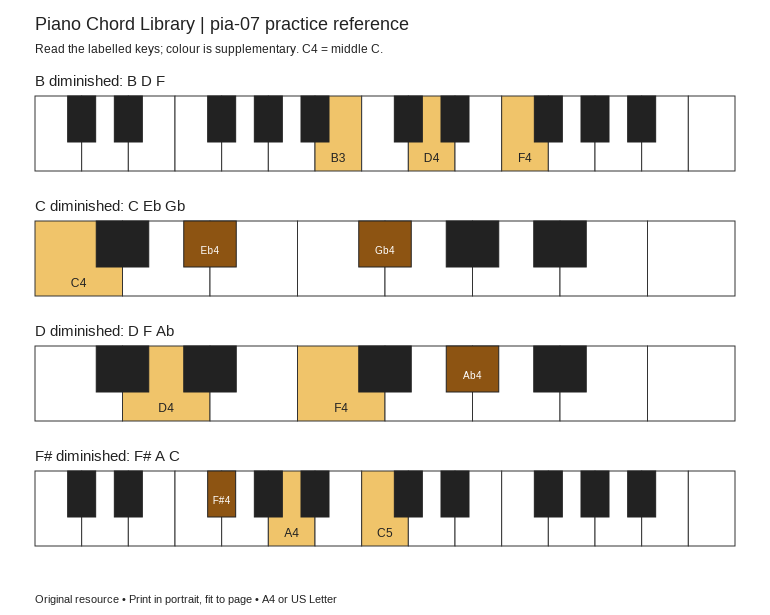
The original diminished-triad sheet shows B, C, D and F-sharp examples. Hear them in that order below, first broken and then together. For comparison, the chord reference contains major and minor triads on the same roots. This guide keeps the three-note triad separate from the seventh-chord families.
Build B diminished using only white keys
Start on B3 and choose the third-based letters B, D and F. B to D is three semitones: C is one, C-sharp is two and D is three. D to F is also three semitones. The outside distance B to F totals six, so the fifth is diminished. No accidental is needed for this particular root.
Play B and F alone before adding D. This tritone is the interval that differs from B minor's outer fifth. B minor would use F-sharp, seven semitones above B. Alternating B–D–F-sharp with B–D–F lets you hear one altered note rather than comparing unrelated chords in different registers.
An all-white-key appearance does not mean a chord is major. C–E–G is major, D–F–A is minor and B–D–F is diminished. Each uses three white keys, but the distances between them differ. The groups of black keys help you count the gaps that a purely visual white-key pattern can conceal.
Use both construction methods
The root-distance method places the third three semitones above the root and the fifth six above it. The stacked method places the third three above the root and the fifth another three above the third. Both reach the same notes. Mixing the methods accidentally, such as adding six above the third, produces a different chord.
For D diminished, D–F supplies the first minor third. F–A-flat supplies the second, giving D–F–A-flat. The letters D, F and A establish root, third and fifth; the flat adjusts the fifth to the required size. Writing G-sharp instead of A-flat would conceal the fifth-based structure even though the key is the same.
For F-sharp diminished, the notes are F-sharp, A and C. F-sharp to A is three semitones, and A to C is three. This is a useful sharp-root contrast to D diminished. It requires only one sharp, but that does not make it a different quality. The interval formula stays constant.
Why C diminished needs G-flat
C diminished is C–E-flat–G-flat. The note G-flat is a fifth above C by letter count and six semitones above it by pitch distance. F-sharp sounds on the same piano key, but C to F-sharp is a fourth by letter count. The spelling tells you whether the altered interval is functioning as a fourth or fifth.
This distinction matters when you move the chord into a progression or write it on a staff. The chord members should be recognisable as a stack of thirds. C–E-flat–F-sharp does not show that stack clearly. Correct notation is useful information about the relationship between the notes, rather than a demand to produce a different sound on the keyboard.
Double accidentals can appear from some roots. C-sharp diminished is C-sharp–E–G, while D-flat diminished is D-flat–F-flat–A-double-flat. Those two root spellings use the same keys in equal temperament but preserve different letters. For early practice, choose familiar spellings while understanding why a more theoretical spelling may be required by context.
Hear B diminished move toward C major
B is the seventh degree of C major. Building a triad from alternate notes of that scale gives B–D–F, so B diminished can be labelled vii°. In a simple leading-tone resolution, B rises to C and F falls to E. Those two half-step movements help connect the diminished chord to the tonic.
Try the original pair B3–D4–F4 followed by C4–E4–G4. The root-position shift is easy to read, although the middle and upper voices need not all follow their nearest destinations in this particular block layout. For a clearer voice-leading exercise, play B3–F4 alone moving to C4–E4, then add a separate C major chord at the arrival.
Notice that the diminished triad does not contain G, the root of G7, even though both chords contain B, D and F when G7 is complete. That shared material helps explain their related pull in C major. Still, B diminished and G7 are different chord spellings, and the bass and surrounding texture affect how each is heard.
Find a different role in minor
In A natural minor, the second degree is B. Stacking alternate scale notes gives B–D–F again, now labelled ii°. The same chord can therefore have a different scale-degree role in a different key. Its internal quality remains diminished, while its relationship to the tonic changes.
Play an original A minor sequence: Am, Bdim, E7, Am. Use A–C–E, B–D–F, E–G-sharp–B–D, then A–C–E. The B diminished chord prepares the dominant E7, and E7 leads to A minor. G-sharp belongs to the altered dominant harmony, even though the first two chords can be built from A natural minor.
Keep this first version slow and divide notes between hands as needed. Then try a reduced sequence with bass notes A2, B2, E3 and A2, and upper pairs C4–E4, D4–F4, G-sharp3–D4 and A3–C4. The middle dominant omits its fifth B, while its third and seventh remain clear.
Do not confuse the triad with diminished sevenths
B diminished has three distinct notes: B, D and F. Add A and the result is B half-diminished seventh, often written Bø7 or Bm7(b5). Add A-flat instead and it becomes B fully diminished seventh, Bdim7 or B°7. Both four-note chords share the same diminished triad but have different sevenths.
Play the three-note chord first, then add A, release, and add A-flat. Keep B–D–F unchanged during the comparison. The two upper additions lie a semitone apart, so you can hear exactly what separates the seventh-chord families. Calling every one of these sounds simply diminished loses information that a performer needs.
Chord-chart shorthand can vary. Some writers use dim or a small circle with an implied seventh in a jazz context, while elementary theory often uses the same basic symbol for the triad. Read any chart legend and consider the written notes. In this guide, diminished triad always means the three-note form, and dim7 explicitly means the four-note form.
Keep the chord identity when you rearrange it
B3–D4–F4 is root position. D4–F4–B4 is first inversion, and F4–B4–D5 is second inversion. The lowest note changes, but the three pitch classes remain B, D and F. A diminished triad does not become another chord family simply because a fourth or sixth appears between adjacent voices after rearrangement.
Use the bass as a separate label. Bdim/D specifies a B diminished chord with D lowest. Before deciding whether a printed group of notes is diminished, restore their root-based order mentally. The root is the start of the third stack; it is not automatically the lowest note currently played.
Rearrangement also changes physical demands. You may prefer to play B in the left hand and D–F in the right for one progression, then move to a different distribution for the next. Choose a layout that lets the intended lines connect comfortably. A diagram identifies notes and register; it is not a compulsory fingering instruction.
A checked diminished-triad exercise
Listen for the outer interval in a different register
Play C4 and G-flat4 without the third, then move both notes down one octave. The interval remains a diminished fifth, but its register changes the listening experience. Add E-flat in each register and compare the complete triads. This exercise prevents you from attaching the chord name to only one familiar height on the keyboard. Keep the volume moderate and release the previous sound before replaying the lower example.
Next spread the chord as C3–G-flat3–E-flat4. The third now sits above the fifth, so the adjacent gaps no longer look like two minor thirds. Identify the chord from its pitch classes, then put the notes back into C–E-flat–G-flat order to verify the formula. The sound may feel more open, yet it still contains the same root-to-fifth tritone. Naming this stable relationship is more useful than treating each spacing as a new chord.
For a small listening challenge, alternate C diminished with C minor while keeping the bass C3 and upper third E-flat4 unchanged. Use G-flat3 for the diminished version and G3 for the minor version. The changed note is now in the middle rather than at the top. If you can hear the difference only when the fifth is highest, repeat this arrangement slowly and focus on that inner line. Recognition across different placements takes a different kind of attention from identifying a labelled root-position diagram.
Build A diminished, E diminished and G diminished on paper. Their letter frameworks are A–C–E, E–G–B and G–B–D. Applying zero, three and six semitones gives A–C–E-flat, E–G–B-flat and G–B-flat–D-flat. Locate every note, then test the two adjacent minor thirds before playing the complete chords.
Now start from C minor and lower only its fifth. You should move G to G-flat while C and E-flat remain fixed. Next start from C major and make C diminished. This time both E and G must fall a semitone. The different starting points explain why a description such as flatten the fifth is incomplete unless the original chord is specified.
Finish with one musical connection rather than another isolated shape. Play B diminished to C major, or B diminished to E7 and A minor. Write the key and the diminished chord's scale-degree label beside your chosen version. The same notes can serve different roles, and that contextual distinction is the next step beyond recognising the six-semitone fifth.
Theory references
- Introduction to Triads. Reviewed 7 October 2026.
The explanations, exercises, keyboard drawings and synthesized audio on this page are original. References were used to check terminology and theory.