Piano Chord Library
 Rob
An augmented triad is a major triad with its fifth raised by a semitone. C major is C–E–G; C augmented is C–E–G-sharp. The formula is root, major third and augmented fifth, at zero, four and eight semitones. Its two equal major thirds make the chord unusually symmetrical, but correct spelling still depends on which note is being treated as the root.
| Root interpretation | Correct thirds | Context to check |
|---|---|---|
| C augmented | C–E–G♯ | Which voice leads onward from G♯? |
| E augmented | E–G♯–B♯ | B♯ plays the C key but is E’s raised fifth |
| A-flat augmented | A♭–C–E | A♭ plays the G♯ key; the root spelling changes |
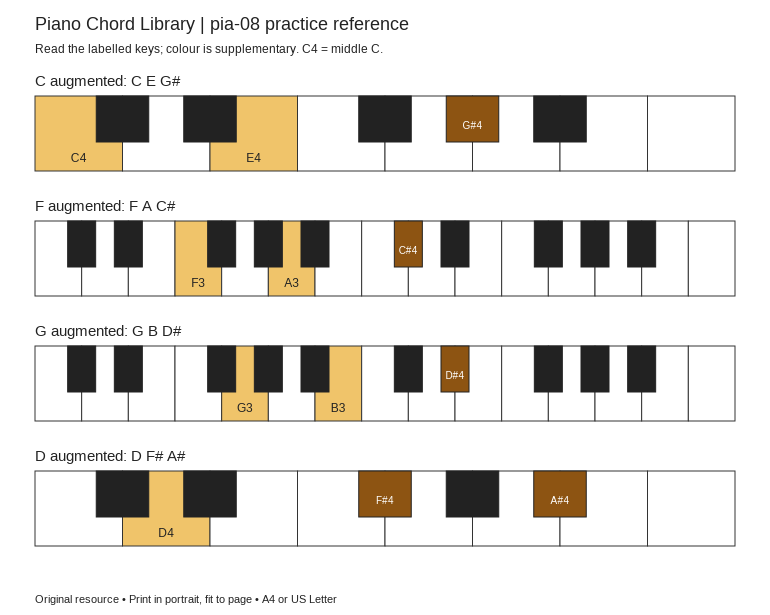
The original augmented-chord sheet shows C, F, G and D examples. The audio plays those four chords, first note by note and then together. The short progressions below are original practice material. Use the major-chord references to check each starting triad before raising its fifth.
Build the two major thirds
Start with C4. A major third above C is E4, four semitones higher. Another major third above E is G-sharp4, another four semitones higher. The total distance C to G-sharp is eight semitones. Count the letter span C, D, E, F, G to confirm that the outer interval is a fifth.
A perfect fifth would reach G natural, seven semitones above C. Raising that G to G-sharp makes it an augmented fifth. This gives two equivalent construction methods: stack two major thirds, or build a major triad and raise its fifth. Compare the answers from both methods if you are unsure of a new root.
Do not raise the third as well. C–F–G-sharp would no longer contain a major third above C and would not be the intended triad. Augmented describes the altered fifth in this chord family, not a general instruction to sharpen every note. Keep C and E fixed while moving only G to G-sharp.
Spell the altered note as a fifth
C–E–A-flat uses the same piano keys as C–E–G-sharp in equal temperament, but A-flat is a sixth above C by letter count. G-sharp shows that the fifth has been raised. This distinction helps a reader recognise the chord structure and follow a line such as G–G-sharp–A through a progression.
For F augmented, the letter framework is F, A and C. Raise the perfect fifth C to C-sharp, giving F–A–C-sharp. For G augmented, use G–B–D-sharp. For D augmented, use D–F-sharp–A-sharp. The third-based letters remain stable even when one or two notes fall on black keys.
Some roots require double sharps. B augmented is B–D-sharp–F-double-sharp because the perfect fifth F-sharp must rise another semitone. F-double-sharp uses the G key, but writing G would obscure its fifth role. You do not need to begin with that spelling in a practical exercise; understanding it prevents a later theoretical example from appearing arbitrary.
Compare major and augmented on the same root
Play C4–E4–G4, pause and then play C4–E4–G-sharp4. Listen for the upper G moving to G-sharp. Keep your volume and timing similar. Comparing two controlled versions is more informative than trying to decide whether an unfamiliar chord sounds mysterious or tense, descriptions that can vary with context and personal hearing.
Repeat the comparison on F using F3–A3–C4 and F3–A3–C-sharp4. If the difference is hard to hear, remove A temporarily and compare just the two outer intervals. Then restore the third. You are isolating the changed ingredient before returning to the full blend.
Try the altered fifth in an inner voice as well. Play C3–G3–E4 followed by C3–G-sharp3–E4. The chord identity is the same as before, but the moving note is no longer highest. This develops recognition of the interval structure across different voicings rather than only one visible shape.
An original moving-note progression
Keep C4 and E4 fixed, and move the upper note G4, G-sharp4, A4 and G-sharp4. The first chord is C major, the second C augmented, and the third contains C, E and A. That third collection can be heard as A minor in first inversion, written Am/C, when C remains the bass.
The middle augmented chord gives the chromatic line a distinct harmony while connecting the two more familiar triads. Do not add extra notes yet. Play one shape for four slow counts and listen to G rising through G-sharp to A. Then reverse the line A–G-sharp–G to hear the same collection take part in a descending connection.
The C–E–A collection can have other interpretations in a fuller musical context, such as part of a C sixth chord with G omitted. Here Am/C is a clear label for the complete three-note triad that is actually played. State the intended context rather than assuming a set of piano keys has only one possible chord name.
Let an augmented dominant move toward the tonic
In C major, try G augmented followed by C major. G augmented is G–B–D-sharp. Its B can rise to C, and D-sharp can rise to E while G remains common. An original close connection is G3–B3–D-sharp4 followed by G3–C4–E4. The destination is C major with G in the bass.
For a stronger root-position arrival, change the bass G3 to C3 at the destination while the upper B3–D-sharp4 moves to C4–E4. This final voicing omits C major's fifth G, but the root and third establish the intended quality. Add G4 later if you want the full triad at the end.
The example illustrates one possible use, not a universal rule that every augmented chord must resolve upward. The surrounding melody, bass and style can suggest other destinations. The practical question is which chord tones move by small distances to the next harmony. Follow those actual notes before assigning a dramatic description to the chord.
Why the same keys can suggest several roots
Test the symmetry
C, E and G-sharp divide the octave into three equal four-semitone steps: C to E, E to G-sharp and G-sharp to the next C. That symmetry differs from a major triad's unequal thirds. When the notes are rearranged, another root interpretation can become plausible, especially when the bass and surrounding chords change.
Keep the spelling in context
For example, an E augmented spelling is E–G-sharp–B-sharp. B-sharp sounds on the C key, so it shares its pitch classes with C augmented. The spelling and context identify whether you are thinking of C or E as the root. A keyboard picture without note labels cannot settle that question by itself.
Rearranging C augmented as E–G-sharp–C can still be its first inversion when the musical context keeps C as the root. Reinterpreting it as E augmented instead requires spelling the last note B-sharp and hearing E as the root. Inversion and enharmonic reinterpretation can use the same keys while describing different musical relationships.
Read plus signs and added notes carefully
Caug and C+ commonly name a C augmented triad. A number or other modifier can add further instructions. Cmaj7-sharp-5 and C7-sharp-5, for example, differ in their sevenths even though each contains the augmented triad underneath. Build the three-note form first, then read any added member explicitly.
Do not confuse augmented with suspended. Csus4 replaces the third E with F and normally retains G, while Caug keeps E and raises G. Those are different operations with different sounds. If a chord feels unfamiliar, write the actual notes rather than trying to classify it from an imprecise mental image of a stretched shape.
A focused check you can repeat
- For a written test, distinguish three operations on C major. Raising the entire chord by one semitone gives C-sharp–E-sharp–G-sharp, a transposed major triad. Raising only the fifth gives C–E–G-sharp, the augmented triad. Moving the lowest C above the other notes gives E–G–C, an inversion of the original major triad. These operations can all produce less familiar keyboard shapes, but they change different musical properties. Write root, quality and bass separately for each result. That small record prevents transposition, alteration and inversion from becoming interchangeable words when you describe what your hands have done.
- Build A augmented and E-flat augmented before looking at the answers. A major is A–C-sharp–E, so raising its fifth gives A–C-sharp–E-sharp. E-flat major is E-flat–G–B-flat, so its augmented version is E-flat–G–B natural. The B-flat has been raised to B, not automatically changed to a sharp sign.
- Play both chords as separate tones and verify the two major thirds. A to C-sharp is four semitones and C-sharp to E-sharp another four. E-flat to G is four and G to B four. These examples check that raising a pitch is an operation on its current accidental, not a rule that every altered fifth must display a sharp symbol.
- Finish with the original C–Caug–Am/C line. Name the moving fifth G, G-sharp and A as you play, and keep the common C and E as steady as possible. You have then connected the augmented formula, its correct spelling, its distinctive sound and one practical musical use within a short, repeatable exercise at the piano.
Theory references
- Introduction to Triads. Reviewed 7 October 2026.
The explanations, exercises, keyboard drawings and synthesized audio on this page are original. References were used to check terminology and theory.