Piano Chord Library
 Rob

A dominant chord is built on the fifth degree of a key. Its familiar major triad is labelled V, and adding a minor seventh produces V7. In C major these are G and G7. The dominant often leads back to the tonic, C, creating a clear sense of arrival. The most revealing piano exercise is to follow the individual notes through that change.
| Term | Example in C major | What it tells you |
|---|---|---|
| Dominant triad | G–B–D | Major triad built on degree five |
| Dominant seventh | G–B–D–F | Major triad plus minor seventh |
| Dominant function | G7 approaching C | A relationship to a tonic; context is essential |
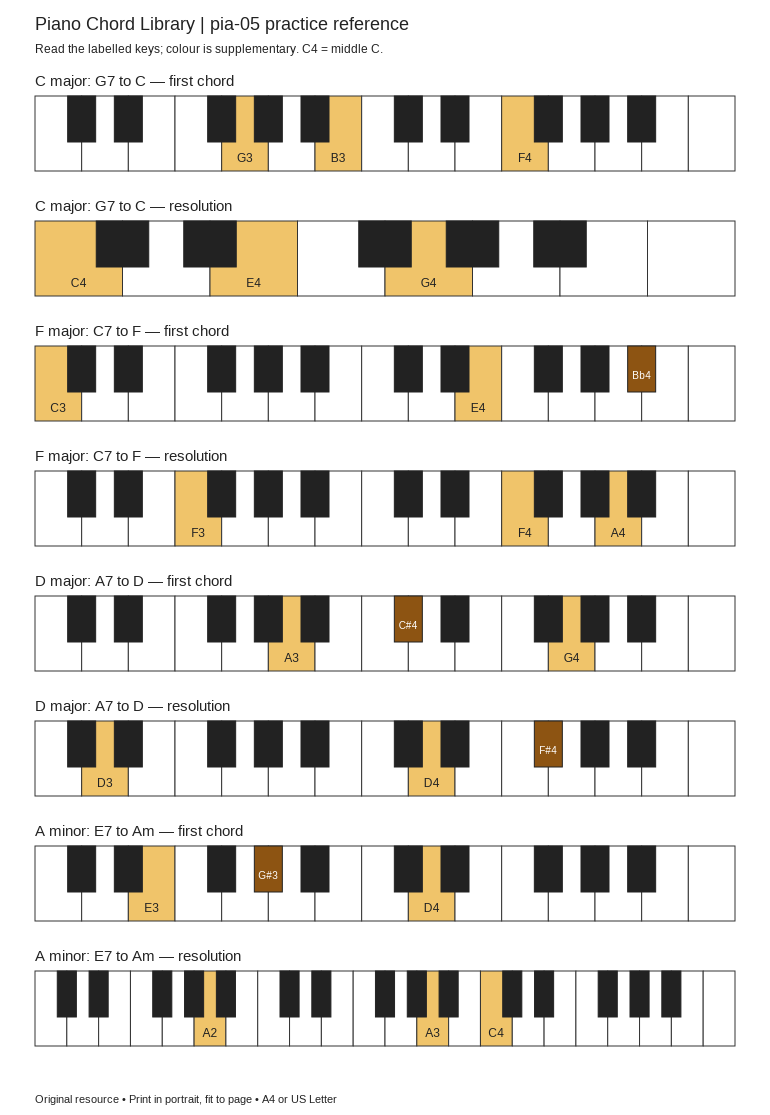
Use the original resolution sheet with the audio below. It demonstrates G7–C, C7–F, A7–D and E7–Am using compact voicings that leave out selected fifths. The examples are original and are intended for comparing voice movement. The chord library can help you check the destination major and minor triads.
Separate a chord's quality from its job
The word dominant has two related uses. Within a key, the dominant is scale degree five and the chord based on it. As a chord-quality label, dominant seventh means a major triad with a minor seventh above its root. G7 contains G, B, D and F wherever it appears, but its role depends on what the surrounding music establishes as home.
In C major, G7 is V7 because G is the fifth degree. In a passage centred on G, the same G7 might serve a different purpose, such as a tonic-quality blues chord. Do not decide the key from a chord symbol alone. Ask which note and harmony feel established as the tonal centre, then describe the chord's relationship to them.
The distinction also explains why C7 does not usually mean the dominant of C. C7 names the root C and dominant-seventh quality. In a straightforward F major context it is V7 of F. The dominant seventh of C is G7. Saying both the chord name and destination is an effective way to keep those meanings clear.
Build a dominant seventh correctly
Measure zero, four, seven and ten semitones above the root. For G7, G is zero, B is four, D is seven and F is ten. The chord has a major third, perfect fifth and minor seventh. The major third is essential to distinguish it from Gm7, while the minor seventh distinguishes it from Gmaj7.
You can also begin with G major, G–B–D, and add F a whole step below the next G. That upper F is a minor seventh above the root. Adding F-sharp instead would create Gmaj7. This one-note difference changes an important internal relationship, so say the seventh's actual name whenever you practise the construction.
Build A7 as a second example. A–C-sharp–E supplies the major triad, and G supplies the minor seventh. The spelling C-sharp shows that the note is the third above A. D-flat would use the same key but describe a fourth by letter count. Keep the chord's third-based framework visible in your written practice notes.
Hear the two notes that point toward C
Inside G7, B and F form a tritone. In a standard resolution to C major, B rises by a semitone to C, while F falls by a semitone to E. These two movements turn the tense inner pair into notes of the tonic triad. Start with only B3 and F4, then move to C4 and E4.
Add G3 below the first pair. This gives G–B–F, a G7 voicing without the fifth D. For the arrival, play C4–E4–G4. This is the first recorded example. The missing D does not prevent the comparison because the root, third and seventh establish the dominant quality, and the destination supplies a complete C major triad.
The dominant's fifth can be included in fuller arrangements, and voice-leading choices vary with style and texture. The point here is to isolate a clear, common resolution. These small examples are not a complete set of rules for four-part classical writing; they are playable reductions that let you hear the leading tone and chordal seventh move.
Transfer the movement to F major
The fifth degree of F major is C, so its dominant seventh is C7: C, E, G and B-flat. The important upper pair is E and B-flat. E lies a semitone below F, while B-flat lies a semitone above A. Moving E up to F and B-flat down to A outlines the same kind of resolution as B–F moving to C–E.
For the recorded voicing, play C3 with the left hand and E4–B-flat4 with the right. Move to F3 in the left hand and F4–A4 in the right. The tonic omits C, its fifth, and doubles F instead. That is intentional: the compact two-note upper movement is the feature being demonstrated.
After learning the reduced version, add G4 to the C7 and C5 to the F major chord if the distribution is comfortable. Compare the fuller texture with the simpler one. The extra tones enrich the sound but do not change the named chords. You should still be able to follow E–F and B-flat–A inside the larger arrangement.
Check a sharp-key example
In D major, A7 is V7 and D major is I. A7 contains A, C-sharp, E and G; D major contains D, F-sharp and A. C-sharp rises to D and G falls to F-sharp. Both movements are semitones, matching the C and F major demonstrations despite different keyboard colours.
The audio uses A3–C-sharp4–G4 followed by D3–D4–F-sharp4. The first chord omits E and the second omits A. Play the upper pairs C-sharp4–G4 and D4–F-sharp4 without the bass first. Once that change is secure, add the roots. This division keeps the listening task focused while the left hand learns a separate movement.
If D major sounds wrong at the arrival, check F-sharp. Using F natural creates D minor and changes the destination quality. A dominant can resolve to either a major or minor tonic, but the choice should be intentional. The chord symbol and the notes you play must agree even when both results sound musically plausible.
Why minor keys often use a major dominant
A natural minor contains A, B, C, D, E, F and G. Stacking notes on E from that collection gives E minor, E–G–B. Raising G to G-sharp creates E major, and adding D creates E7. G-sharp is a semitone below the tonic A, giving the dominant a leading tone that the natural-minor G does not provide.
Play E minor followed by A minor, then E7 followed by A minor. The first progression has its own sound; it is not an error. The second makes the G-sharp-to-A movement especially clear. The raised seventh degree is a common feature of tonal minor harmony, which is why a minor key does not restrict every chord to the natural-minor collection.
The recorded reduction is E3–G-sharp3–D4 moving to A2–A3–C4. G-sharp rises to A, and D falls to C. Unlike the major-key examples, the descending upper movement is a whole step because C is the minor third of A. This is a useful detail: the familiar dominant-to-tonic pattern adapts to the destination's actual notes.
Hear the roots without confusing the direction
V to I is commonly described as root motion down a fifth, or equivalently up a fourth. G down to C below spans a fifth, while G up to C above spans a fourth. Both arrive at the same tonic pitch class in different registers. Choose a practical bass register and label the octave if the exact direction matters.
The first recorded example uses G3 to C4, an upward fourth. The D major example uses A3 to D3, a downward fifth. Those bass routes sound different in register but express the same scale-degree move, five to one. This is why Roman numerals describe harmonic relationships more generally than a single keyboard shape.
Try the C major pair with both bass routes while keeping B3–F4 moving to C4–E4 above. You may need to rearrange duplicated notes to avoid one hand colliding with the other. The exercise is about comparing register choices. A lower bass is not automatically more correct, and a larger jump is not automatically more musical.
A small practice cycle with clear checks
- Choose one destination key and say its tonic aloud. Find scale degree five, build its major triad and add the minor seventh. Write the full chord before choosing a reduced voicing. This order separates knowing the chord from deciding how to distribute it between your hands.
- Next isolate the third and seventh of the dominant. Identify their intended tonic destinations and play just those two moving lines. Add the bass only after the upper pair is secure. Repeat at a slow, regular pace, allowing the tonic a little more time so you can hear it as an arrival rather than rushing immediately back to the dominant.
- Finally transpose the task to one new key. If you choose B-flat major, the dominant is F7: F–A–C–E-flat. The leading tone A rises to B-flat, while E-flat falls to D. Test those two lines, then add F and B-flat roots. This single new example demonstrates whether the method transfers beyond the four recorded pairs.
What a resolution does and does not prove
Make the bass and upper voices agree
A useful troubleshooting exercise is to hold the upper pair B–F while changing only the bass. First play it over G, then over C. The second result is not the intended C major arrival because B and F have not resolved. This makes a frequent practical mistake audible: the left hand reaches the new root while the right hand retains the old harmony for too long. Practise the moment of change slowly enough that all intended voices move together.
Try the opposite experiment as well. Move B–F to C–E while keeping G in the bass. You now have C major over G, a second-inversion tonic voicing. Its pitch collection is recognisably C major, but its bass does not give the same root-position arrival as C in the bass. Both experiments can be musically useful in other contexts; here they show which part of the expected resolution is missing. Record a slow attempt and listen once for the bass, then again for the upper voices, instead of trying to assess every detail simultaneously.
A V–I move can occur inside a phrase or at its ending. Calling something a cadence involves the arrival's position and effect within the phrase, not only spotting two chord symbols. Likewise, a dominant can move somewhere other than the expected tonic. The expectation is useful precisely because music can delay or redirect it.
For an original comparison in C, play G7 to C, then G7 to Am. The second destination shares C and E with C major but changes the bass and chord quality. It may feel like the expected close has been diverted. This common kind of deceptive movement is a good reminder that dominant harmony suggests possibilities rather than enforcing one inevitable next chord.
Finish by checking three things: the chord contains a major third and minor seventh, the V label matches the named destination key, and the notes in the resolution move where your explanation says they do. When construction, context and sound agree, you can use dominant chords as understandable musical relationships rather than isolated grips.
Theory references
- Introduction to Seventh Chords. Reviewed 7 October 2026.
- Cadences. Reviewed 7 October 2026.
The explanations, exercises, keyboard drawings and synthesized audio on this page are original. References were used to check terminology and theory.