Piano Chord Library
 Rob
A musical interval describes the relationship between two notes. Its number tells you how many letter positions the notes span; its quality tells you which version of that span you have. C to E is a third, while C to E-flat is also a third. Their different keyboard distances make the first major and the second minor. Learning to check both parts prevents many chord and scale mistakes.
To apply these distances to several notes at once, follow how to build piano chords from intervals. Compare the third and fifth above the same root before moving to a different starting note.
| Interval | Semitones | Example |
|---|---|---|
| Minor second | 1 | C–D♭ |
| Major second | 2 | C–D |
| Minor third | 3 | C–E♭ |
| Major third | 4 | C–E |
| Perfect fourth | 5 | C–F |
| Augmented fourth / diminished fifth | 6 | C–F♯ / C–G♭ |
| Perfect fifth | 7 | C–G |
| Minor sixth | 8 | C–A♭ |
| Major sixth | 9 | C–A |
| Minor seventh | 10 | C–B♭ |
| Major seventh | 11 | C–B |
| Perfect octave | 12 | C–C above |
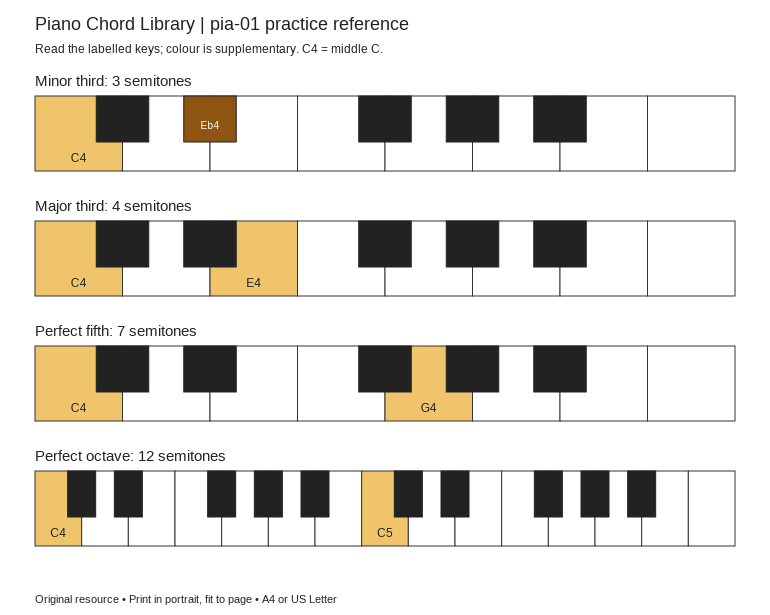
Use the printable interval comparison beside your keyboard. The original audio below compares a minor third, major third, perfect fifth and octave from middle C, first as separate notes and then together. Middle C is labelled C4 throughout this guide. The piano scales chart provides a wider setting for the same relationships.
Count letters for the interval number
Begin with the written note names, without letting sharps or flats distract you. Count the starting letter as one and include the destination. C, D, E covers three letter positions, so C to any kind of E is some kind of third. C, D, E, F, G covers five positions, so C to any kind of G is a fifth. This counting convention is inclusive: it counts positions, not movements between piano keys.
Try D to A. Say D as one, E as two, F as three, G as four and A as five. You have a fifth before you consider its exact size. D to A-flat remains a fifth because the letters have not changed. D to G-sharp uses only four letter positions, making it a fourth, even though G-sharp and A-flat can use the same piano key.
The letter count explains why a unison is numbered one. Two written Cs at the same register occupy the same letter position. An octave goes from one C to the next C: C, D, E, F, G, A, B, C gives eight positions. The repeated letter does not make the interval a unison because the register has changed.
Count movements for the keyboard distance
A semitone, also called a half step, is the distance to the immediately neighbouring piano key, whether that key is black or white. Set the starting note to zero and count movements. From C to C-sharp is one semitone; from C to D is two; from C to E-flat is three; from C to E is four. Do not count the starting key as a semitone.
This gives you two deliberately different counting methods. Letter positions include the starting note because they measure a written span. Semitone movements start at zero because they measure pitch distance. Confusing those methods makes a major third appear to have five semitones. Trace the route C, C-sharp, D, D-sharp, E, and count the four movements between those five keys.
E to F and B to the next C are each one semitone. There is no black key between either pair. Conversely, D-flat to E-flat spans a whole tone, even though both keys are black: D natural lies between them. The colour of the two endpoints cannot tell you the size reliably. Look for every intervening key.
Add the interval quality
Seconds, thirds, sixths and sevenths commonly occur in major and minor forms. The minor form is one semitone smaller than the major form of the same numbered interval. Unisons, fourths, fifths and octaves use the term perfect for their reference form. Perfect does not mean morally better or always pleasant; it is a classification used in interval naming.
From C upward, D-flat is a minor second and D is a major second. E-flat is a minor third and E a major third. F is a perfect fourth; G is a perfect fifth. A-flat is a minor sixth and A a major sixth. B-flat is a minor seventh and B a major seventh. The next C is a perfect octave.
These names combine spelling and distance. You can verify the usual distances in the chart: one and two semitones for the seconds, three and four for the thirds, five for the perfect fourth, seven for the perfect fifth, eight and nine for the sixths, ten and eleven for the sevenths, and twelve for the octave. Six semitones sits between the perfect fourth and perfect fifth, requiring closer attention to spelling.
Why six semitones has two common names
C to F-sharp spans four letters and six semitones, making it an augmented fourth. C to G-flat spans five letters and six semitones, making it a diminished fifth. A piano produces the same pitches for these two examples in equal temperament. Written notation nevertheless distinguishes their roles. F-sharp can act as a raised fourth; G-flat can act as a lowered fifth in a chord.
Augmented means one semitone larger than a perfect or major interval of the same number. Diminished means one semitone smaller than a perfect or minor interval of the same number. Thus C to G-sharp is an augmented fifth, while C to E-double-flat is a diminished third. The latter uses the D key on an equal-tempered piano, but its spelling still requires a third.
You do not need to practise every theoretical spelling immediately. It is more useful to understand why the name cannot be recovered from a keyboard distance alone. If a worksheet gives only two lit keys and no written notes, some interval spellings are ambiguous. A good answer can state the assumed spelling rather than pretending the keyboard resolves it.
Three worked examples away from C
D to F-sharp
The letters D, E and F establish a third. Count D to D-sharp, E, F and F-sharp: four semitone movements. A third spanning four semitones is major, so the answer is a major third. Check it musically by playing D, F-sharp and A as a D major triad. The interval you identified sits between its root and third.
B to F
Moving upward through B, C, D, E and F gives five letters. The key path B, C, C-sharp, D, D-sharp, E, F contains six movements. A perfect fifth would require seven semitones, so this fifth is diminished. Notice that both endpoints are white keys. White notes do not guarantee a perfect interval or a major chord.
E-flat to C above it
Count E, F, G, A, B, C to establish a sixth. The distance from E-flat to C is nine semitones. That is a major sixth. You can also check its inversion: move the lower E-flat above C and C to E-flat becomes a minor third. The two distances, nine and three, complete an octave.
Ascending, descending and simultaneous intervals
A melodic interval uses notes in succession. A harmonic interval sounds both notes together. Either can illustrate the same written distance, but the listening task changes. In the audio, C followed by E makes the upward movement easy to follow. C and E together let you hear the blend without a melodic journey between them.
Direction matters when describing a melody. C5 down to G4 is a descending perfect fourth: the pitch falls five semitones. C4 up to G4 is an ascending perfect fifth: the pitch rises seven. Both examples involve the pitch classes C and G, but their actual register and direction produce different intervals. Pitch classes alone omit that information.
For a descending exercise, write the actual upper and lower pitches before counting. E5 down to C5 is a descending major third, because C5 to E5 spans a major third. Do not automatically call it a sixth merely because you can also find a higher C above E. That would describe a different destination.
Use inversion as a checking tool
- To invert a simple interval within an octave, move its lower note up an octave, or its upper note down an octave. The interval numbers add to nine: a second becomes a seventh, a third becomes a sixth, and a fourth becomes a fifth. Major and minor exchange; perfect stays perfect; augmented and diminished exchange.
- Play C4 and E4, then E4 and C5. The major third becomes a minor sixth. The distances are four and eight semitones, adding to twelve. Next play C4 and F4, then F4 and C5. The perfect fourth becomes a perfect fifth, with distances five and seven. This is a useful physical demonstration of the number rule.
- Inverting an interval is different from turning a melody upside down, and it is also more specific than rearranging a whole chord. Use the term carefully. Here there are exactly two notes, and one crosses the other by an octave. When checking a difficult sixth or seventh, reducing it to the complementary third or second can save counting.
Intervals larger than an octave
A compound interval extends beyond the octave. C4 to D5 is a ninth, while C4 to E5 is a tenth. Count the letters across the octave boundary and the names follow naturally. Their qualities match the corresponding simple intervals: the ninth is major, like C4 to D4; the tenth is major, like C4 to E4.
Adding an octave adds seven to the interval number and twelve to its semitone distance. A major second of two semitones becomes a major ninth of fourteen. A minor third of three becomes a minor tenth of fifteen. The number grows by seven because the shared octave boundary is not counted twice.
On the piano, a compound interval may be easier to divide between hands. You are studying the relationship, not testing your reach. Play the lower note with the left hand and the upper note with the right. Keep the register labels in your notes so that a ninth does not silently become a second when you return tomorrow.
A focused interval practice sequence
Before starting, choose a register and write it on the practice sheet. Middle C through the C above it gives a compact area where the examples are easy to locate. Keep the sustain pedal released for the first comparisons so that the previous pair does not blur into the next. If the sound is difficult to judge, replay only the two notes you are comparing, at similar volume, before adding another interval category.
Start with just minor and major thirds. Play C4 to E-flat4, pause, then C4 to E4. Say the destination name before playing. Repeat from D with F and F-sharp. The small change in the upper note is easier to compare than two unrelated examples in different registers. Listen again without looking and identify which version came second.
Next add perfect fourths and fifths. From D4, compare G4 and A4. Sing or hum each upper note after playing the lower note if that is comfortable, then check at the keyboard. A missed sung pitch is information about the exercise, not a judgement of musicianship. Slow down and return to only two choices when the categories blur.
Finish by reading six written prompts before touching the instrument: C–A, D–F, E–B, F–B-flat, G–E-flat and A–C-sharp, all ascending within an octave. Identify the letters first and the distance second. The answers are major sixth, minor third, perfect fifth, perfect fourth, minor sixth and major third. Explain one answer aloud rather than merely checking a label.
Keep written and listening results separate. You may name a printed major sixth accurately while finding its sound unfamiliar. In that case, practise listening comparisons. If the sound is familiar but the note spelling causes mistakes, write and verify intervals in several keys. Matching the practice to the actual error is more productive than repeating every exercise equally.
Common questions at the keyboard
Can a sharp make an interval smaller?
Yes. Raising the lower note brings it closer to a fixed upper note. C to E is four semitones, but C-sharp to E is three. Raising the upper note has the opposite effect. Always identify which endpoint changed before applying a rule about size; the accidental symbol alone does not tell you whether the interval widened.
Is every octave exactly the same physical width?
The pitch distance is twelve semitones in the tuning assumed here, but the hand position differs with the starting key. A C octave uses two white keys and an F-sharp octave uses two black keys. The theory name describes the pitch relationship. It does not prescribe one hand shape or require you to hold an octave stretch.
Should I memorise the table before playing?
Use the table as a reference while learning a few intervals through actual notes. Building D to F-sharp, hearing it and recognising it inside D major connects three kinds of knowledge. Memorising labels without those links can leave the keyboard unfamiliar. Once the method is clear, more interval names become variations of a process you already understand.
Theory references
- Introduction to Intervals. Reviewed 7 October 2026.
- Augmented and Diminished Intervals. Reviewed 7 October 2026.
The explanations, exercises, keyboard drawings and synthesized audio on this page are original. References were used to check terminology and theory.