Piano Chord Library
 Rob
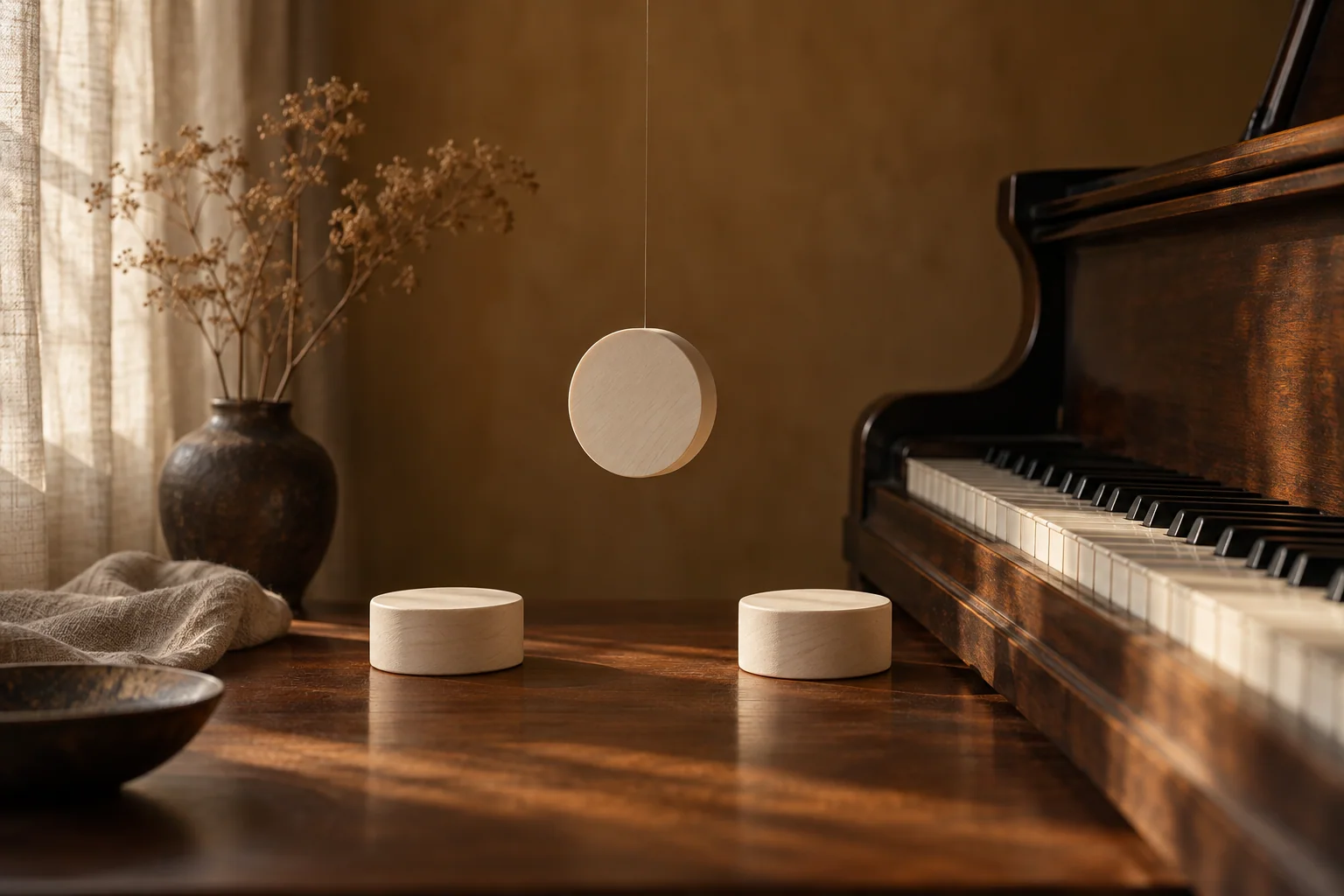
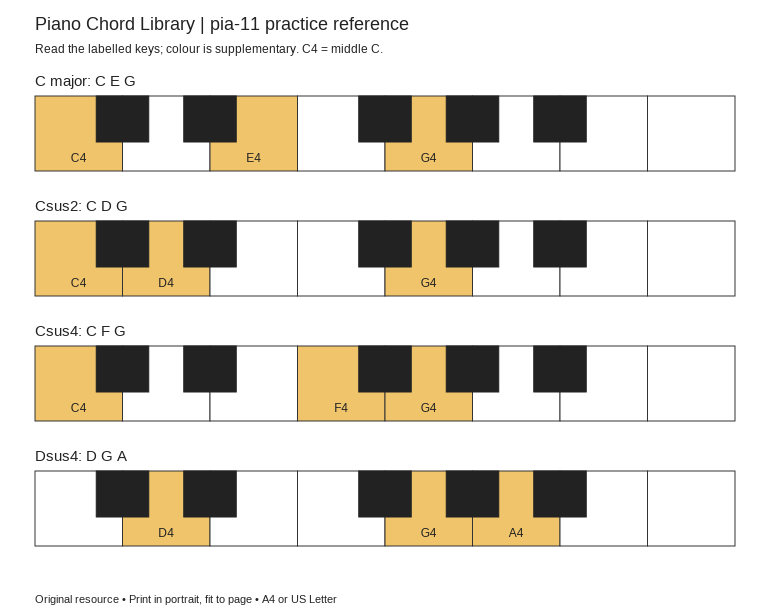
A suspended chord replaces the third of a triad with a second or fourth while retaining the root and fifth. Csus2 is C–D–G; Csus4 is C–F–G. C major, C–E–G, contains E instead. Because the third is missing, the basic suspended chord does not state the major or minor third that would normally identify that quality.
| Symbol | Notes | Is the third present? |
|---|---|---|
| Csus2 | C–D–G | No: D replaces E |
| Csus4 | C–F–G | No: F replaces E |
| Cadd9 | C–E–G–D | Yes: D is added |
Use the original sus-chord comparison and listen to C major, Csus2, Csus4 and Dsus4 below. Each appears as separate tones followed by a full chord. The major and minor chord references let you compare the triads before replacing their thirds.
Identify what changes and what remains
Start with C major: C4, E4 and G4. For Csus2, move E down to D while keeping C and G. For Csus4, move E up to F instead. The two new chords share their outer C–G perfect fifth, but their middle notes occupy different scale-degree positions above C.
The formula for sus2 is root, major second and perfect fifth, at zero, two and seven semitones. The formula for sus4 is root, perfect fourth and perfect fifth, at zero, five and seven semitones. These are root-based distances, so every number is measured from C in the example, not from the previous chord member.
The word replace is useful. If you keep E and add D, you have included the third as well as the second or ninth, giving an added-note sound rather than the basic Csus2 collection. If a chord chart specifically asks for Csus2, do not assume that adding every nearby scale note will preserve its intended character.
Build sus2 from another root
Dsus2 contains D, E and A. E is a major second above D, and A is a perfect fifth. Compare it with D major, D–F-sharp–A, and D minor, D–F–A. Replacing either version's third with E gives the same basic Dsus2 notes, which explains why the suspended symbol itself does not specify a major or minor third.
For B-flatsus2, use B-flat, C and F. The second C sits two semitones above B-flat, and F is seven above. The black-key root does not change the formula. Say the second as an interval above the named root rather than counting two white keys to the right.
Listen to the close root-and-second pair in each example. C and D in Csus2, or D and E in Dsus2, form a whole step. Moving the second up an octave changes the spacing while preserving its pitch class. That wider placement can be convenient, but the chord still omits its third unless you deliberately add one.
Build sus4 and hear its possible resolution
Dsus4 contains D, G and A. G lies a perfect fourth above D, and A a perfect fifth. Moving G down to F-sharp produces D major; moving it down to F produces D minor. The destination determines which third appears. The suspended chord itself can precede either, depending on the musical context.
Play D4–G4–A4 followed by D4–F-sharp4–A4. Keep D and A steady while G falls a semitone. Now repeat with G falling a whole step to F. The first arrival is major and the second minor. The different size of the resolving movement is a concrete detail you can hear and verify.
For Csus4 to C major, F falls to E by a semitone. For Csus4 to C minor, F falls to E-flat by a whole step. Avoid a universal rule that the suspended fourth always resolves by a half step. Its destination is a chord tone in the chosen harmony, and that may be a major or minor third.
A sus symbol and a prepared suspension are related ideas
In traditional voice-leading terminology, a suspension is a note prepared in one harmony, held into a new harmony where it creates a dissonance, then resolved, commonly downward by step. The word describes a process over time. A modern sus chord symbol describes a collection of chord tones and need not show all those stages.
For an original preparation exercise, play F major with F3 in the bass and A3–C4–F4 above it. Then change the harmony to C by playing C3 with G3 while holding F4. Finally move F4 to E4. The upper F began as part of F major, persisted over the C harmony and resolved to its third E.
The middle sonority can be represented by Csus4, but the whole example demonstrates more than the symbol alone: it shows preparation, suspension and resolution. If you simply strike C–F–G together with no preceding preparation, it is still a usable Csus4 chord, though that isolated attack does not by itself demonstrate a prepared suspension.
A suspended chord need not resolve immediately
In many chord-based styles, a sus sonority can be held, repeated or used as an independent colour. You do not have to add a major third after every Csus4 simply because the word suspended suggests waiting. The chart, melody and surrounding harmony indicate whether a resolution is intended.
Try an original two-chord loop, Csus2 and Fsus2. The notes are C–D–G and F–G–C. Play a C bass under the first and F under the second, keeping common C and G in nearby registers. The changing bass and remaining D-to-F movement create a pattern without introducing E or A, the usual thirds of the corresponding major triads.
Then play C major and F major as a separate comparison. Their E and A give a more explicit major quality. Neither version is automatically better. The useful observation is what information the third supplies, and what changes when the arrangement leaves that information unstated.
Rearrange a sus chord carefully
Csus2 in root position can be C4–D4–G4. Spread it as C3–G3–D4 to open the close second into a ninth above the bass. The pitch classes remain C, D and G. The second-derived note does not become a third merely because it changes octave, so the suspended quality remains.
The same pitch classes can also spell Gsus4 as G–C–D. If G becomes the perceived root, the interpretation changes. A keyboard shape alone cannot tell you whether C or G is the harmonic centre. Use the bass, chord symbol and surrounding progression to decide which root-based description is useful.
This overlap is a good reason to learn sus2 and sus4 through intervals, not just through mirrored-looking hand shapes. Csus2 and Gsus4 can use the same notes, while Csus2 and Csus4 differ by D versus F. Root and role are necessary parts of an accurate comparison.
Add a seventh only when the symbol asks for it
C7sus4 normally contains C, F, G and B-flat. It combines the suspended fourth with a minor seventh and omits the ordinary third E in the basic spelling. Compare it with C7, C–E–G–B-flat. The move F to E changes the suspension while B-flat remains as the seventh.
A practical original resolution is C3 with B-flat3–F4, moving to C3 with B-flat3–E4, then F3 with A3–F4. The first two voicings omit G. You can hear the suspended fourth resolve within the dominant, followed by C7 moving to F. This gives the F-to-E change a different context from a standalone Csus4-to-C-major pair.
Keep the plain sus4 and 7sus4 labels distinct in your notes. If B-flat appears, it is an additional chord member that affects the sound and possible function. A short symbol can carry several instructions, so read root, suspension and seventh separately before playing.
A small comparison routine
Use a melody to check whether the third is really absent
A chord symbol describes the intended harmony, but the complete sound also includes the melody. Suppose your left hand plays C–G and your right hand alternates D and E. On the D event, the sounding collection can suggest Csus2; on the E event it states C major. If you hold D while adding E, the resulting collection includes both the second and third. Listen to the whole texture before describing the passage as one unchanged suspended chord.
For a controlled original exercise, play C3 and G3 together and hold them for four slow counts. Above them play D4 on count one, E4 on count two, F4 on count three and E4 on count four, releasing each upper note before the next. The sequence passes through sus2, major, sus4 and major sonorities over the same open fifth. The changing melody supplies the information that the bass pair alone cannot provide.
Now repeat while holding each melody note longer so that it overlaps the following one. The sound becomes more complex because additional pitch classes accumulate. This version can be interesting, but it no longer makes the same clean four-way comparison. Release the sustain pedal and separate the attacks when your purpose is identifying each chord collection. Later you can choose overlap deliberately as an arrangement effect.
This is also a useful check for chord-chart playing. If a written melody already contains the third over a sus accompaniment, do not ignore it in your analysis. The arrangement may intentionally combine them. Describe what is actually sounding, and use the chart's conventions to understand whether the suspension symbol indicates a strict omission or a looser accompaniment colour.
Choose D as a fixed root. Play D major, Dsus2, Dsus4 and D minor, keeping A as the fifth throughout. The changing member is F-sharp, E, G and F. This sequence makes the third's presence or absence audible without a new bass note distracting you from the comparison.
Next choose F and construct Fsus2 and Fsus4 on paper. The answers are F–G–C and F–B-flat–C. The fourth requires B-flat, because F to B natural would span an augmented fourth rather than the required perfect fourth. This example checks whether you are measuring the interval instead of assuming all-white notes will work.
Finally decide what musical task you want the suspended chord to perform. For a clear resolution, practise Dsus4 to D major and trace G to F-sharp. For an unresolved colour, repeat the Csus2–Fsus2 loop. Describing the intended movement or sustained sound makes the chord a deliberate choice rather than an unexplained alteration of a triad.
Theory references
- Simple Sus Chords. Reviewed 7 October 2026.
The explanations, exercises, keyboard drawings and synthesized audio on this page are original. References were used to check terminology and theory.