 Piano Chord Library
 Rob
Rob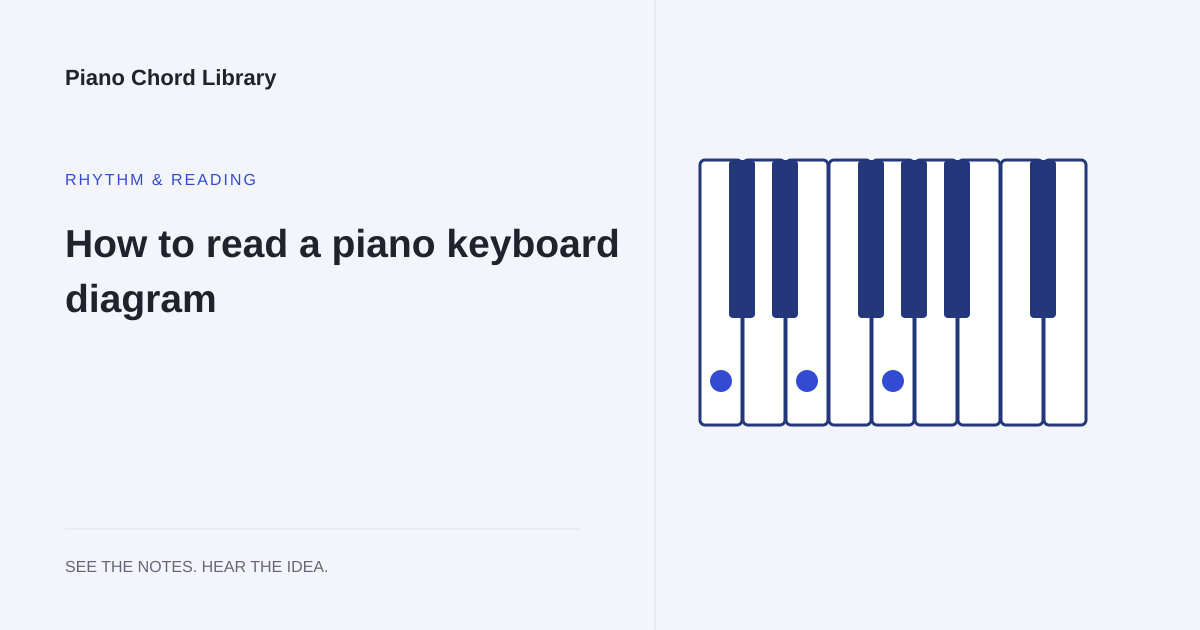
Start with the groups of black keys
The black keys repeat in groups of two and three. C is the white key immediately left of a group of two. From C, the white keys are C, D, E, F, G, A, B, then C again. Moving right raises the pitch; moving left lowers it.
Count adjacent keys
A semitone (half step) is the distance to the next key, including black keys. A whole step is two semitones. E–F and B–C are already adjacent white keys: there is no black key between them.
Read sharps and flats as names
A sharp raises a written note by one semitone; a flat lowers it by one. C♯ and D♭ use the same black key in equal temperament. That shared sound is called enharmonic equivalence. The correct name depends on the chord or scale being written.
The same rule explains white-key accidentals: E♯ sounds on F, and C♭ sounds on B. A double sharp raises by two semitones; our tools show it as ♯♯.
What the highlights mean
Each highlighted key is one note in the displayed position. Active notes have labels, and the complete note list appears above the diagram. Unselected white keys carry octave numbers for orientation. The keyboard is a visual reference; use the Play button to hear the selection.
Try it
Open B-flat major. Find the root in the group of three black keys, then identify D and F. Compare the same three note names in its inversions.
Background: The Major Scale, University of Puget Sound.