Piano Chord Library
 Rob

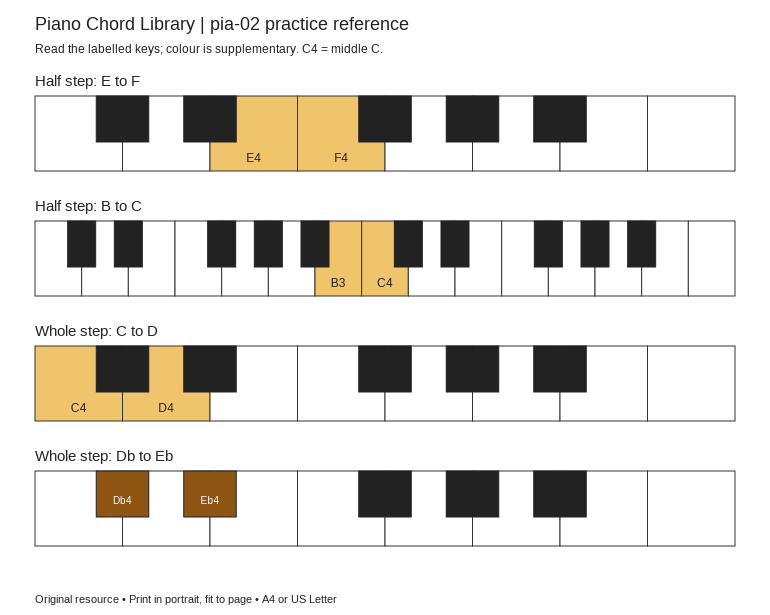
A half step, or semitone, moves to the next piano key with no key between. A whole step, or whole tone, moves two half steps and skips one intervening key. Count every key, black and white. E to F and B to C are half steps even though both notes are white; C to D is a whole step because C-sharp lies between them.
| Distance | Semitones | Examples |
|---|---|---|
| Half step | 1 | E–F; B–C; C–C♯ |
| Whole step | 2 | C–D; E–F♯; B–C♯ |
Open the original keyboard reference to compare white-to-white, white-to-black and black-to-black examples. The audio plays E–F, B–C, C–D and D-flat–E-flat in that order. You can also use the major-scale explorer to see how these two distances build a complete scale.
Find the nearest key by pitch
Look at the keyboard as one ordered row of pitches. The black keys sit farther back physically, but they belong in the same pitch sequence as the white keys. Between C and D sits C-sharp, also called D-flat. If you move directly from C to D, you have passed over that black key. You travelled two semitones rather than one.
Try touching C, C-sharp, D, D-sharp and E very slowly. Each movement is a half step. The five touched keys form four movements. That distinction matters: starting on C does not itself create a distance. Treat C as your zero point and say one, two, three, four as you move to each new key.
Now continue from E to F. You still move a half step, although the new key is white. The next movement, F to F-sharp, is also a half step. The keyboard alternates colours irregularly because the pattern of natural note names contains two adjacent pairs without an intervening black key. Pitch distance remains consistent across those changes in colour.
Learn E–F and B–C as landmarks
White-key half steps
Find a group of two black keys. C is the white key immediately to their left; E is the white key immediately to their right. F begins the next group of three black keys. E and F therefore meet at the boundary between the two groups. There is no hidden key to include between them.
Check the neighbouring black keys
At the other boundary, B is the white key to the right of the group of three, and C begins the next group of two. Play B3 and C4, then E4 and F4. Each pair is a semitone. Listen for the similar small movement even though the examples occupy different places on the keyboard.
A common early mistake is to call every neighbouring white-key pair a whole step. That works for C–D and D–E but fails for E–F. Another is to call every black-to-white move a half step. C-sharp to E disproves that: D and D-sharp also lie along the route. Adjacency in pitch, rather than colour, is the deciding feature.
Build a whole step from two small movements
From F, move first to F-sharp and then to G. F to G is a whole step. From B, move first to C and then to C-sharp. B to C-sharp is also a whole step, although the destination is black. From E, move to F and then F-sharp. E to F-sharp is another whole step.
Black keys can form whole steps too. D-flat to E-flat travels through D natural. G-flat to A-flat travels through G natural. Check each by playing the middle key quietly before playing the two endpoints alone. This makes the skipped pitch concrete rather than something to count mentally.
A whole step downward uses the same distance in reverse. D down to C goes through D-flat; C down to B-flat goes through B. If you are unsure, break the task into two neighbouring movements and then remove the middle note. There is no separate downward formula to memorise.
Separate key distance from note spelling
On an equal-tempered piano, C-sharp and D-flat use the same key. The names describe different written contexts. C to D-flat is a minor second, while C to C-sharp is an augmented unison. Both travel one semitone, so the keyboard distance alone does not settle the complete interval name.
Likewise, E to F-sharp is normally described as a major second. E to G-flat sounds at the same distance but uses a different letter span, making it a diminished third. You can learn whole and half steps before mastering these interval labels. Just avoid concluding that every two-semitone spelling must be a written second.
For the scale exercise below, give each successive note a new letter. A seven-note scale proceeds through A, B, C, D, E, F and G in order from whichever letter starts it. Accidentals then adjust those letters to the required distances. That rule is why an F major scale uses B-flat rather than A-sharp.
Use the pattern to construct F major
A major scale follows whole, whole, half, whole, whole, whole, half. Begin on F and work one movement at a time. A whole step reaches G, another reaches A, and a half step reaches B-flat. The next three whole steps reach C, D and E. The final half step returns to F in the next octave.
The completed notes are F, G, A, B-flat, C, D, E, F. Play A followed by B natural once, then A followed by B-flat. The first choice travels a whole step and breaks the required pattern at that point. The second travels a half step and fits. This is a useful correction because it links the accidental to a specific distance.
Do the same check near the top. E to F supplies the final half step without an accidental. Two different-looking parts of the keyboard fulfil the same distance requirement. The pattern controls the scale; the number of black keys is a consequence of the starting note, not the definition of major.
Listen to one distance at a time
Play C4 and D-flat4 successively, leaving a short pause between them. Then play C4 and D4 with the same timing and volume. Keeping the first note fixed makes the difference easier to notice. The half step is the smaller movement; the whole step travels a little farther. Avoid changing register and distance together at first.
Ask a practice partner to play one of those pairs, or record four choices in an order you will not immediately remember. Answer only half or whole. Once that feels manageable, repeat with E4–F4 and E4–F-sharp4. This transfers the listening task to a new starting note while retaining exactly the two distances.
The reference audio is a labelled demonstration rather than a random test. First use it to establish the examples. Later listen with the written order covered and describe what you hear before revealing the notes. Recognising the four-item order is easier than identifying distances in unfamiliar material, so change the order at the keyboard when you can.
A short identification exercise
- Classify these ascending pairs before playing them: F–G-flat, A–B, B–C, C-sharp–D-sharp, E-flat–E and G–A-flat. Write down the intervening key for every whole step. If there is none, mark the pair as a half step. This extra step checks your reasoning rather than allowing a lucky label to hide a counting mistake.
- F–G-flat is a half step. A–B is a whole step with B-flat between. B–C is a half step. C-sharp–D-sharp is a whole step with D between. E-flat–E and G–A-flat are half steps. For the last two pairs, the changing accidental moves the endpoint by only one key; no additional pitch is skipped.
- Now reverse the pairs and play them downward. Their sizes remain the same. Next invent one white-to-white half step, one black-to-black whole step and one white-to-black whole step. E–F, D-flat–E-flat and B–C-sharp are possible answers. Making an example yourself reveals whether you understand the rule beyond the original list.
Correct mistakes without speeding up
If your answer is consistently one semitone too large, check whether you counted the starting key as one. If your answer is wrong only near E–F or B–C, pause at those boundaries and trace every key. If sharp and flat names slow you down, locate the key first, then say the spelling requested by the exercise.
Keep physical reach out of the definition. A whole step played high on the black keys may feel different from a whole step near the front of two white keys. The distance in pitch has not changed. Use separate fingers or even separate hands if necessary while you are learning the relationship; no fixed fingering is required for this identification task.
For a useful finish, choose one major scale in the explorer and locate its two half-step positions. In a major scale they fall between degrees three and four, and between degrees seven and eight. Explain those positions using actual note names. That turns two small keyboard distances into a practical method for checking longer musical patterns.
Theory references
- Half Steps and Whole Steps. Reviewed 7 October 2026.
The explanations, exercises, keyboard drawings and synthesized audio on this page are original. References were used to check terminology and theory.