 Piano Chord Library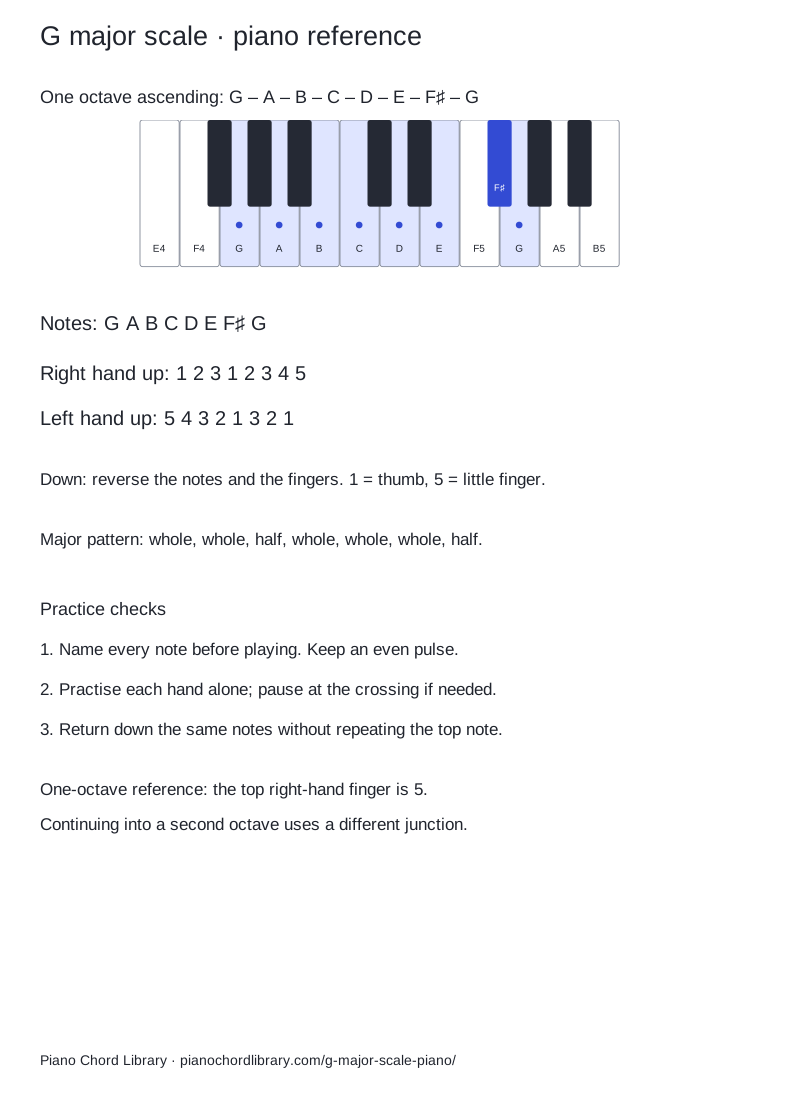
Make the hand change deliberate
Right hand: move the thumb onto C after B with finger 3; finger 4 plays F-sharp. Left hand: after the thumb plays D, finger 3 crosses onto E, followed by finger 2 on F-sharp and the thumb on G.
The top right-hand finger is 5 when you finish this single octave. Continuing into another octave uses the thumb at the octave junction instead. Do not apply the one-octave endpoint unchanged to a longer scale. Keep the movement comfortable and ask a teacher to adapt a fingering if needed.
A short practice task
Isolate E–F-sharp–G, then reverse G–F-sharp–E. Use right-hand fingers 3–4–5 and left-hand fingers 3–2–1 going up. Listen for the smaller F-sharp–G step. Then join this ending to G–A–B–C–D.
Play one note per steady beat. Pause and restart a fragment if the crossing creates a rush or a gap. Once each hand feels predictable, try both hands in separate octaves at a slower pace. Their crossings occur at different notes, so learn that coordination without increasing speed at the same time.
Hear the scale inside a chord
Select G, B and D from the scale to form G major. The scale needs F-sharp even though the G major triad does not contain F at all. Add the seventh scale degree F-sharp to hear Gmaj7; use F natural instead to hear G7.
A mistake you can diagnose
Replacing F-sharp with F natural changes the collection. Do not call G–A–B–C–D–E–F–G a G major scale. The same black key can be called G-flat elsewhere, but this scale needs one of each letter, so its name here is F-sharp.
Listen to the reference once, then name and play the notes yourself with the sound stopped. Cover the fingering table and write the ascending sequence before checking it. This separates remembering the notes from relying on the highlighted picture.
Compare C major · Print major and natural minor scales in all keys · Explore six scale families
Fingering cross-checked with Fergus Black’s scale guide, C and G major sections. This page’s diagrams and practice tasks are original; it is not an exam syllabus.